Itinerary
Any great trip to Japan should include some unmissable stops and – great news – we have them all covered! We will start in Tokyo, the modern capital that reflects the frenzy and effervescence of the country, We will then explore Kyoto, with its temples and historic neighbourhoods, Hiroshima, reborn after the Second World War, and, last but not least...Osaka, home of Japanese cuisine.
Modern will meet tradition - in Tokyo we will be surrounded by skyscrapers and will cross the busiest intersection in the world, but once we travel down to Kamakura, we'll be immersed in the peace of the Buddhist temples and Zen gardens, not too far from the iconic Mount Fuji. Then we will take the Shinkansen, the high-speed train that has the reputation of never being late. Once in Kyoto we will visit some other majestic temples before walking through the bamboo forest and under the traditional red gates of Fushimi Inari. A jump back in time in Hiroshima, another in Osaka and Himeji Castle, and then we stop in Nara to admire the famous deer walking freely in the city park. We will immerse ourselves in a culture far from ours and uncover all it has to offer - are you ready?

Welcome to Japan
1 night: Tokyo
Check-in: our adventure starts in Tokyo
Roundtrip flights or transportation to reach the destination are not included in the package, so you can decide from where and when you want to leave! This gives you complete freedom of choice to adjust your travel itinerary to your needs.
Hotel check-in in Tokyo and welcome meeting.

From Tokyo to Kamakura to visit the Great Buddha
1 night: Tokyo
Exploring the imperial cities
We kick off our day early in order to make the most of our adventure. Our first destination is Kamakura, an ancient imperial city and one of the first capital cities of Japan. We'll explore a variety of temples and palaces, each one offering a glimpse into Kamakura's rich history. One of the highlights of our visit will be the Great Buddha, a magnificent statue that has stood the test of time, surviving numerous typhoons and even a tsunami that ravaged the temple surrounding it. It's also one of the very few Buddha statues that can be visited from the inside. Shall we go in?
Wander through the capital
We head back to Tokyo by train and arrive refreshed and ready to explore more of the city's culture and history. We visit Ueno Park, one of the most popular parks in the city, home to many temples and shrines. The most notable is the Gojo Tenjinsha Shinto shrine, which can be reached by walking through a pathway lined with traditional red torii gates. Food is a fundamental part of any country's culture, so tonight's dinner will be no exception. We immerse ourselves in the vibrant streets of Ameyoko Market, near Ueno Park. Let's get our taste buds ready!

A first taste of Kyoto: Kawaramachi, Gion and Nishiki Market
1 night: Kyoto
Japanese bullet trains
Another early morning to embark on a journey aboard one of Japan's iconic bullet trains. Our destination is Kyoto, known for its rich history and beautiful temples. We'll experience the efficiency and punctuality of the Japanese railway system as we travel at high speeds and arrive at our destination in no time. Will we be able to catch a glimpse of snow-capped Mount Fuji?
Kawaramachi
As we arrive in Kyoto in the afternoon, we'll check into our hotel and get ready to explore this beautiful city. Known for its rich history and cultural heritage, Kyoto is one of the most picturesque cities in Japan. Our first stop will be the neighbourhood of Kawaramachi, where we can stroll through the streets filled with shops and izakayas, typical small restaurants. After a walk through the neighbourhood, we'll head to Nishiki Market, a must-see destination for any food lover. Here, we'll find an array of street food stands offering a wide variety of Japanese delicacies such as sushi, sashimi, fresh fish, yakitori, gyoza and even sweet treats like melon pan and matcha-flavoured ice-cream.
After satisfying our taste buds, we'll make our way to Gion, a famous district known for its traditional teahouses and geishas. As we walk through the streets, we'll have the chance to spot geishas dressed in their traditional attire. The best time to visit Gion is at sunset – it's selfie time!

Kyoto: Fushimi Inari Shrine and the Golden Temple
1 night: Kyoto
Walking tour of the city
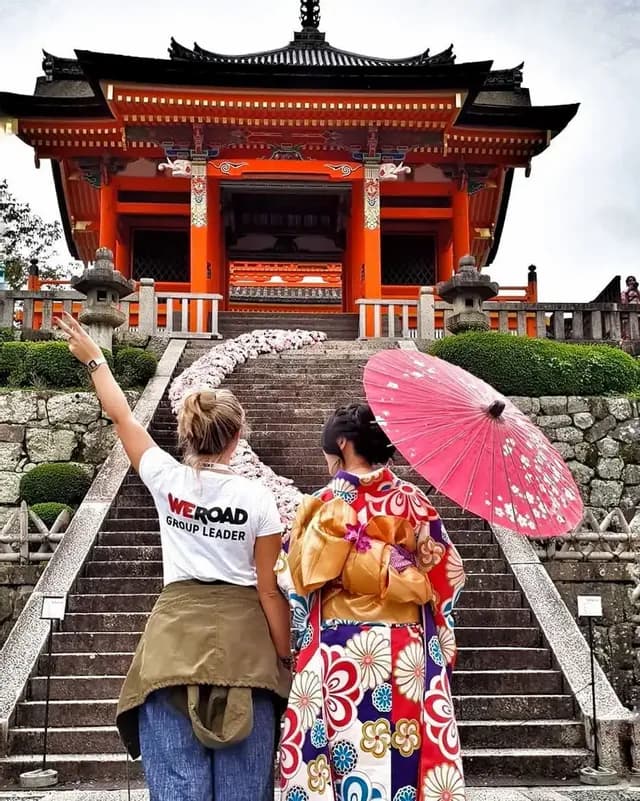
Today we delve deeper into the rich cultural heritage of Kyoto by visiting some of its most iconic and historic sites. There are 17 UNESCO World Heritage Sites and over 700 Shinto temples here... but unfortunately we won't have time to visit them all! A must-see is definitely Fushimi Inari Shrine, a Shinto place of worship known for its thousands of red torii gates that lead up to the mountain's summit. We'll also visit the iconic Kyomizu-dera Temple, which is renowned for its sacred water.
The Golden Temple
After lunch, we head east to visit one of Japan's emblems: the Kinkaku-ji Temple, also known as the Golden Temple. The temple is covered in gold leaves that, when illuminated by sunlight, create a stunning reflection on the pond in front of it. In Japanese culture, gold symbolizes purification from negative thoughts, so we can expect to leave with clear and peaceful minds after visiting this beautiful site. We end the day at Ryoanji Temple, where we can stroll through the largest Zen garden in Japan. Have we found inner peace yet?

Kyoto: Bamboo Forest and some DIY exploring
1 night: Kyoto
Bamboo Forest
We spend the morning in Arashiyama, the neighbourhood where we can get lost in the magical Bamboo Forest – a place that you may have seen on Instagram, as it's probably one of the most photogenic places in Japan. To truly experience the magic of the forest, we'll be getting an early start and be there when the crowds are minimal. We'll have the opportunity to wander through the forest and park and then visit the Tenryuji Temple, one of the five Zen temples in Kyoto. It's the perfect way to start our day, surrounded by natural beauty and serenity.
Shall we shop or relax?
In the afternoon, we have the option to have a leisurely stroll around the city and do some shopping or indulge in a traditional Japanese spa experience at an onsen. Throughout our stay in Kyoto, we may have noticed locals dressed in traditional attire such as kimonos for women and hakamas for men. If we choose to do so, we can also experience dressing up in traditional attire and immerse ourselves in the local culture for a truly unique evening.

Hiroshima: history and spirituality
1 night: Hiroshima
Miyajima
We bid farewell to the picturesque city of Kyoto, where we have spent the past three days, and head to the train station for our next journey via bullet train. After a three-hour ride, we arrive in Hiroshima and make our way to the port to board a ferry to Miyajima Island. A must-see attraction here is the iconic Great Torii, a free-standing gate situated in the sea that creates mesmerising reflections on the water. We will take a leisurely stroll down the main street of the town, where we will have the opportunity to indulge in a variety of street food options. Be mindful of the friendly, yet quite hungry, deer wandering around the area.
Hiroshima
Today, we pay our respects to the tragic history of Hiroshima as we visit Memorial Park, a solemn reminder of the devastating effects of the first nuclear attack in human history. On 6 August 1945, the city was destroyed and many lives were lost. As we walk through the park, we will come across various memorials and monuments that honour the victims of the bombing. We may also have the opportunity to hear from local guides who volunteer their time to keep the memory of this tragic event alive.

From Himeji Castle to Osaka: let's taste the famous okonomiyaki
1 night: Osaka
Himeji Castle
We board the Shinkansen once more and make our way to the city of Himeji, renowned for its iconic castle, which has stood for over 400 years and miraculously survived the bombings of World War II. We'll explore the city centre and search for the perfect viewpoint to capture a photo of the castle and its pagoda-style roofs that will make us feel like on a film set.
Osaka
Osaka is the third most populated city in Japan and is renowned for being the most liberal one as well. Surely tonight will be the right time to find out if what they say is true! Before going out and living the Osaka nightlife, we need to taste okonomiyaki, a savoury pancake that one simply cannot skip during a trip to Japan. After all, Osaka is also the food capital of Japan! We will embark on an exciting 3-hour guided food tour to try a bunch of different local delicacies! After all the delicious food, we'll walk up to Osaka Castle to burn off the calories.

Nara and its deer
1 night: Osaka
Making new friends in Nara
Nara was one of Japan’s capital cities, which is the reason why there are so many historical and cultural sites. We arrive in the morning and we have the whole day to explore temples, gardens and pagodas – but most importantly, we can meet the 1,200 deer that live in Nara-koen Park. They are semi-wild deer that roam freely around the park: in order to conquer their hearts, we can buy a pack of deer crackers and feed them.
Besides the deer, there are many sites that we can visit – choosing which ones will be a very hard task! We can start with Daibatsu-den, the biggest wooden building in the world that enshrines a 17-metre tall Great Buddha and then continue with Kasuga-taisha Shrine, the most important Shinto shrine in Nara, and Naramachi, the traditional district of shops, restaurants, workshops and ryokan (traditional Japanese inns). Just remember: we only have one day, let’s make the most out of it!

Tokyo: from old neighbourhoods to modern ones
1 night: Tokyo
Tokyo
Another bullet train journey and we're back in Tokyo in less than 3 hours, ready to fully enjoy this megalopolis and its neighbourhoods.
Asakusa will be our starting point, as it is the heart of old Tokyo. Once again, we can dive into Japanese culture and history, visiting Senso-ji Temple and its pagoda. Near the temple, there are so many food stands, meaning that even today we’ll get the chance to try out Japanese street food. Before leaving, let’s not forget to make a wish with an omikuji, a typical Japanese fortune ticket.
Ueno
After lunch, we move to Ueno, a popular neighbourhood with a huge park, many museums, temples, shrines and even a zoo. During the blooming season, Ueno Park is the place to be: if we are here around March and April, we can come and enjoy the cherry blossoms as Japanese do. It’s called hanami - literally, “flower viewing”. We could even go on a rowing boat ride if we feel like it!
Next is a stroll through the Yanaka District, one of the few areas that weren't bombed during World War II, before we return to Shinjuku for dinner and maybe to join the locals for a great night out in one of the many bars in the area.

Tokyo and its thousand districts: Shibuya
1 night: Tokyo
Harajuku and Shibuya
Let's continue our tour of Tokyo: this morning we start with Harajuku, the street fashion neighbourhood where crazy fashion trends originate, such as the Gothic Lolita or Ganguro. Then we move from modern times into older ones as we reach Yoyogi Park and visit Meiji-Jingu – a Shinto shrine dedicated to the Emperor – and then walk along Takeshita-dori, a modern street full of shops. It's the perfect time to buy some souvenirs!
After lunch we go to Shibuya, a chaotic neighbourhood that is always crowded. Does the name sound familiar? Well, that’s because the busiest crossroad in the world is here! Will we be able to 'go with the flow' of the many Japanese crossing Shibuya everyday? Let’s try!
Last evening in Japan
Believe it or not, but we’re already getting close to the end of this trip. What a better way to celebrate than with a nice farewell dinner? However, our tour couldn't be complete with the utmost Japanese activity – karaoke! Let's clear our throats, everyone sing!

Goodbye Japan!
Check-out and goodbye
Check-out and goodbye – until your next WeRoad adventure!
What's included
10 nights hotel in twin room with private bathroom
Local experience: three-hour local food tour with English-speaking guide
7-day Japan Rail Pass from day 3 to day 9
- Travel Coordinator services
Free cancellation with 100% refund up to 31 days before departure.
Medical and baggage insurance - (coverage limits by destination country/region - €10,000 Italy, €20,000 Europe, €30,000 World, €50,000 USA/Canada)
What's not included
Food and beverages unless specified
All souvenirs and extras that you wish to buy and will be able to squeeze in your backpack
- Anything not mentioned in the "What's included" section
Money pot
The Money Pot is approximately £150/€180 for this trip and is collected on-site by the Travel Coordinator on the first day. The amount of the Money Pot will vary based on the number of activities and extras that the group decides to do.
- Local transports
- Coordinator's money pot share
- All extra activities that each member of the group agree on doing and the coordinator's fee as well
Additional info
- Accommodation
Small hotels and hostels.
The first hotel will be shared with you at least 2 days before your departure by your Travel Coordinator!
- Transport
Tokyo underground, Shinkansen train for long distances and local transport when possible.
- Staff
Our trips are led by a Travel Coordinator who has been specifically trained by us to lead group travels to ensure you have the best time. A WhatsApp group with all travel participants will be created two weeks prior to departure by your Travel Coordinator.
- Luggage
Backpacks are mandatory to allow easy transfers - we recommend a 45L backpack for our trips.
- Private Room Option Show all details
Why WeRoad
-
Small groups, on average 11 people
-
Free cancellation with 100% refund up to 31 days before departure
-
Book with a £/€100 deposit
The travel coordinators
Find your flight
For this trip, we recommend arriving and departing from these airports.
FAQs – Frequently Asked Questions
About this trip
This journey begins at Tokyo. On the first day, we meet at 18:00.
Your Coordinator will add you to the WhatsApp group for your trip about 15 days before departure.
It’s a great way to start getting to know your travel mates, receive more details about the first day’s meeting point, and ask any pre-departure questions you might have.
This journey ends at Tokyo. On the last day, you are free to leave at any time, so whether you need to book a flight, a train, or wish to continue the journey on your own, you can organize your return as you prefer.
We will walk a lot every day to explore the cities.
For this itinerary, soft luggage is required for logistical reasons and the convenience of the whole group - including yourself! Soft luggage includes backpacks, duffel bags, or sports bags, but not trolleys or bulky suitcases. The Travel Coordinator will provide guidance on the ideal baggage before departure via the WhatsApp group.
About Japan
If you are a UK citizen, to find out the entry requirements for Japan, you can check this informational page from our partner Sherpa. If you need a visa, you can apply for it through Sherpa. If you are not a UK citizen, you can still use Sherpa by changing the nationality in the 'Passport' section.
Before traveling, always remember to check the government website of your country of origin for updates on the entry requirements for Japan – you wouldn’t want to stay home due to a bureaucratic detail!
- UK residents: review the FCDO Travel Advice.
- US residents: consult the US Department of State Travel Advice.
- Other residents: refer to your government or local consulate's travel advice.
Japan is in Japan Standard Time (JST), which is 9 hours ahead of GMT. Japan does not observe daylight saving time, so the time difference with the UK differs throughout the year.
The currency in Japan is the Japanese Yen (JPY). You can easily exchange your Euros or other currencies at airports, banks, and authorized currency exchange counters throughout the country.
It's always a good idea to compare exchange rates to get the best deal.
Credit cards and debit cards are widely accepted in Japan, especially in major cities, department stores, and hotels. However, many smaller shops, restaurants, and rural areas might only accept cash. It's a good idea to carry some Japanese Yen with you. ATMs are available in convenience stores and banks, and you can use international cards there. Mobile payment apps like Suica or PayPay are also becoming more popular and might be handy during your stay.
Tipping is not customary in Japan, and in many cases, it can even be considered rude. Instead, excellent service is expected, and the price you see is the price you pay. If you really want to show your appreciation, you might consider giving a small gift instead. It's always a good idea to respect local customs, so just enjoy the great service you receive without worrying about tipping.
In Japan, staying connected to the internet is pretty easy. You can rent a portable Wi-Fi device at the airport or order one online for delivery to your hotel. These devices provide unlimited data and are convenient for multiple users. Alternatively, you can purchase a prepaid SIM card at electronic stores or convenience stores.
Public Wi-Fi is available in many places like cafes, hotels, and train stations, but it's not as widespread as in some other countries. Japan does not fall under the EU roaming agreements, so make sure your phone is set up for international roaming if you plan to use your home data plan.
The official language in Japan is Japanese. While traveling, you might hear or use some common expressions:
- Hello: Konnichiwa
- Thank you: Arigatou
- Excuse me: Sumimasen
In Japan, they use Type A and Type B plugs. Type A has two flat parallel pins, while Type B has the same two pins plus a grounding pin. The voltage is 100V with a frequency of 50-60Hz. You might need an adapter and possibly a voltage converter for your devices. Check your electronics to see if they are compatible with this voltage to avoid any issues.
The main religions in Japan are Shinto and Buddhism. Shinto is native to Japan and involves various rituals and festivals. Buddhism was introduced from China and Korea and has a significant influence on Japanese culture.
Neither religion has strict practices, and many Japanese people incorporate aspects of both into their lives, along with secular beliefs. There are no specific dress codes or religious holidays that require special preparation for travellers.
For a trip to Japan, pack wisely to make the most of your experience.
Here's a handy list of items to include in your backpack for Japan:
-
Clothing
- Light layers for spring and autumn
- Breathable clothes for summer
- Warm clothing for winter
- A raincoat or umbrella -
Shoes
- Comfortable walking shoes
- Slip-on shoes for temple visits
- Sandals for warmer months -
Accessories and Technology
- Universal adapter for Type A and B plugs, 100V voltage
- Portable charger
- Camera or smartphone for photos -
Toiletries and Medication
- Basic toiletries like toothbrush, toothpaste, and shampoo
- Sunscreen
- Common travel medication like pain relievers, motion sickness tablets, and any personal prescriptions
Japan's weather can vary greatly, so it's best to check the forecast before you go.
Japan's weather varies greatly depending on the region and season. Here's a quick guide:
- Hokkaido (North): Cold winters with heavy snowfall, mild summers. Best time to visit is summer for outdoor activities.
- Tokyo (Central): Hot and humid summers, mild winters. Spring (March to May) and autumn (September to November) are ideal for visiting.
- Kyoto & Osaka (West): Hot summers, cool winters. Spring and autumn are perfect for enjoying cherry blossoms and autumn leaves.
- Okinawa (South): Subtropical climate with warm temperatures year-round, occasional typhoons in late summer.
For a pleasant experience, consider visiting during spring or autumn when the weather is generally mild across the country.
Travel insurance is not legally required for visiting Japan, but it is highly recommended. Medical care in Japan can be expensive, and having travel insurance can cover unexpected medical expenses, trip cancellations, or lost items.
It's peace of mind for your journey, knowing you're covered in case of unforeseen events. Make sure your insurance covers the activities you plan to do.
Cherry blossom season in Japan typically starts in late March and lasts until early May, depending on the region. In warmer areas like Tokyo and Kyoto, blossoms usually begin to bloom in late March.
In northern areas like Hokkaido, you can expect them to bloom in late April to early May. Keep in mind that the exact timing can vary each year due to weather conditions, so it's a good idea to check local forecasts as your travel date approaches.
About WeRoad
Return international flights are not included on our trips because we want to give you full autonomy and flexibility. You can choose your preferred airline, fly from the airport that works best for you, and decide how many stopovers you want to make along the way.
As flights are not included, you also have more flexibility with your travel dates: you could arrive at your destination a few days early or return home a bit later – or even continue independently to a nearby destination!
An "Available" departure means that the trip isn’t confirmed yet and we’re waiting for a few more travellers to sign up… which could be you!
If you book the trip please wait for it to be confirmed before booking your international flights.
The question of all questions! Here’s some more information:
- The Money Pot is a common fund collected in local currency from all travellers on the trip and managed by your Travel Coordinator.
- It is used to streamline payments for extra activities, goods and services that the whole group decides to do. This guarantees flexibility in choosing activities and excursions at the destination in line with the mood of the group.
- It is typically collected on the first day of the trip in local currency, although at times, the Travel Coordinator may ask for it to be paid before departure.
- You’ll find the Money Pot amount on the website under the section ‘What’s included in the Money Pot’. To find this look for ‘What’s included’, scroll down to ‘Money Pot? Click here’ and you’ll find the details.
- The amount varies depending on the destination chosen.
- It is usually used for group expenses that all travellers decide to take part in, but sometimes if you opt out of an activity it might make more sense for it to come out of the Money Pot. In these cases the Coordinator will return the amount for this activity back to you at the end of the trip.
- It is estimated based on the experience of other groups but can vary depending on what activities your group is keen for. As such, the Travel Coordinator may need to increase the amount during the trip.
- If not all of the Money Pot is spent, the difference will be returned to all travellers at the end of the trip.
- The Money Pot also covers the Travel Coordinator’s share of the activities included in the Money Pot, except for those activities that are free for the Travel Coordinator.
- If you pay in advance for part of the Money Pot before the trip for certain non-refundable optional activities, unfortunately, the amount cannot be refunded if the trip is cancelled.
We offer several payment methods to fit every need:
1. Credit or debit card (Visa, Mastercard, American Express);
2. Instalment payment with Klarna (you’ll pay for the trip in three equal amounts);
3. PayPal (for selected destinations);
4. Revolut Pay to pay even faster straight from your Revolut account.
Anyone who books a WeRoad trip has the option to cancel or modify the trip – including both the dates and the destination – free of charge up to 31 days before departure. In case of cancellation up to 31 days before departure, you will receive a 100% refund of the WeRoad trip price. If you make a change, a price adjustment will be applied to the new trip chosen – meaning, if the new trip is cheaper, we will refund the difference; if it’s more expensive, you will need to pay the difference.
If you’ve purchased the Flexible Cancellation Option (which you can add in the first step of the booking process), you can request a cancellation or trip change until 8 days before departure. In case of cancellation, you’ll receive a 100% refund of the WeRoad trip price, minus the cost of the Flexible Cancellation option.
How to request a cancellation or change to your trip? Send us an email at [email protected] or a WhatsApp on +447716573700. Please share the booking reference for the trip you want to cancel or change, and, in case of a change, the new trip you would like to join.
For our trips we usually use locally owned accommodation instead of big hotel chains. It’s our favourite way to really experience the local culture and, whenever we can, support the local economy. Typically, you’ll stay in hotels, apartments, guesthouses and hostels with the same standard maintained across all trips in the same destination.
The list of accommodation for your trip will be shared with you by your Travel Coordinator 2-5 days before departure, along with other useful details for your adventure!
Yes! We might not know the flights for everyone else in the group, but there are ways to find out which flights your fellow WeRoaders will be taking.
1. All travellers can share their flight details after booking on their My WeRoad account so that other travellers on the same trip can see these details anonymously.
2. Alternatively you can join our Facebook group: Solo Travellers | WeRoad Community – (here is the extended link: https://www.facebook.com/groups/963298767843213 ) Look for a post about the trip you’re interested in or ask the group admin for help in getting in touch with your future travel companions!
3. If the Coordinator has already been assigned to the trip you’re keen for, you can easily find their Facebook post on the website. Click 'Ask the Coordinator' and follow the link here.
Our groups usually consist of 8–12 travellers, with a minimum of 3–4 and a maximum of 15.
Everyone on our trips speaks English, and travellers join us from across the UK, Europe and beyond. Our trips are open to people in their 20s, 30s, and 40s, with an average age of 34 across all trips.
Each group will be joined and led by one of our experienced Travel Coordinators, who’s there to ensure everything runs smoothly and the group feels well-supported.
If you’d like to know more about our typical WeRoad groups do reach out to us on WhatsApp on +44 7716573700.
Yes! If you're curious, you can take a sneak peek at the group before booking.
You’ll find the info in the ‘Group’ section for each trip on the departures page, showing how many WeRoaders have already booked.
Click the little arrow and you’ll even see their gender and ages – but hey, that’s exclusive info, so we’ll ask you to log in or sign up to see that!
For some trips, in the itinerary section, you’ll find the number of nights and the location (not the hotel) where you’ll be spending the night(s). The location shown is the one we usually go for on most trips, but in some cases, you might stay in a nearby town. This will depend on logistics or availability of accommodation.
The list of accommodation for your trip (and therefore also the exact locations) will be shared by your Travel Coordinator 2-5 days before departure, along with other useful information for your adventure!
The WeRoad Travel Coordinator is an experienced and skilled traveller who will be the perfect companion for your trip. They will manage all the logistical aspects of the itinerary like transport, timings, accommodation, restaurant bookings and meeting points, so that you can enjoy the trip without this hassle. They’re there to support the group, ensure everything runs smoothly and will no doubt make the trip a lot of fun along the way too!
The Coordinator will set up a WhatsApp group approximately 2 weeks before departure. This will be the moment to ask any pre-departure questions and get to know the rest of the group! If the trip you are interested in already has a Travel Coordinator assigned, you can contact them before booking. Their details will be on the trip page, or you can search for their name here. After booking, you will find their contact details in your My WeRoad account, under ‘Bookings and Trips’ > ‘Your Upcoming Trips’ > ‘Trip Details’.
Yes, on all our trips you will share a room with other WeRoaders in your group. By default this will be people of the same gender, unless you tick ‘I'm OK with a mixed gender room’ when you book. The bathroom will either be private or shared only with other travellers on the trip. The rooms might be twins, triples, quadruples or multi-share (up to 8 people in exceptional cases), depending on the destination and availability.
You will never share with people from outside of the WeRoad group, except in certain cases for local experiences, which are specifically mentioned in the itinerary or communicated before booking. These typically involve specific nights in unique accommodation like tents, homestays, or camping, offering a more adventurous travel experience in exchange for some comfort.
On some of our trips we can offer a private room for an additional cost. Just tick the ‘Private Room’ option at checkout to get this added. For some of our trips if you book as two travellers together you can add this private room free of charge. Look out for this option at checkout.
Please note that if you do book a private room with a friend/partner this could be either a double or a twin room so please email [email protected] if you have a preference on this.
When you set off on a WeRoad trip, you’re officially a WeRoader – and as we often say, 'once a WeRoader, always a WeRoader'. This means that once you’re part of the community, a little piece of WeRoad will always stay with you.
But you’re not just a WeRoader during your trips, far from it! The community is alive and active all year round: you can stay in touch by following and interacting on our social media channels, like the Facebook group or the Instagram profile. You can also come along to one of our many events that we run in different cities worldwide. Check out and sign up to our events by downloading the WeMeet app here.


