Itinerary
Embark on a group journey to Tanzania, the land where nature reigns supreme, and be captivated by the breathtaking beauty of East Africa's wildest regions. With imposing baobabs, vast savannahs, and the majestic Big Five, the experience promises to be nothing short of mesmerizing. We'll bid farewell to civilization in Arusha and be immersed in the primitive charm of Tarangire and Serengeti National Parks, where a stroke of luck could reward us with the sight of the wildebeest and zebra migration. We'll then descend into the heart of Ngorongoro crater and search for the king of the savannah, while a visit to Lake Eyasi brings an encounter with the Hedzabe tribe who still live by hunting, just like their ancestors 10,000 years ago. As we prepare for nights under the starry sky, we'll embrace the endless landscapes and the unexpected encounters, all the while knowing that the famous "sickness for Africa" will follow us when it's time to bid Tanzania farewell.


Welcome to Tanzania!
Check-in: our adventure begins in Arusha
Roundtrip flights or transportation to reach the destination are not included in the package, so you can decide from where and when you want to leave! This gives you complete freedom of choice to adjust your travel itinerary to your needs.
The check-in and welcome meeting will be at the hotel in Arusha. Today is the last day before we head off on our amazing adventure; from tomorrow we will sleep in tents, so enjoy the comforts of the hotel for tonight! After taking a walk around Arusha it’s time for a great dinner including some Tanzanian specialities; the national dish, ugali, made of corn polenta served with meat or fish will probably be on the menu!

Tarangire National Park
Towards Tarangire
Today is THE day! This morning we have a few hours to prepare for the safari: check your backpacks and go to the market to stock up on food and drinks. At around 11am we load our jeeps, meet our driver and get ready for the adventure of a lifetime! We leave the city behind and head straight into nature, all the way to the gates of the Tarangire National Park, the first park on our way. The river Taragire flows across the park so expect to see a green landscape with lush swamps and floodplains.
Lions and baobabs
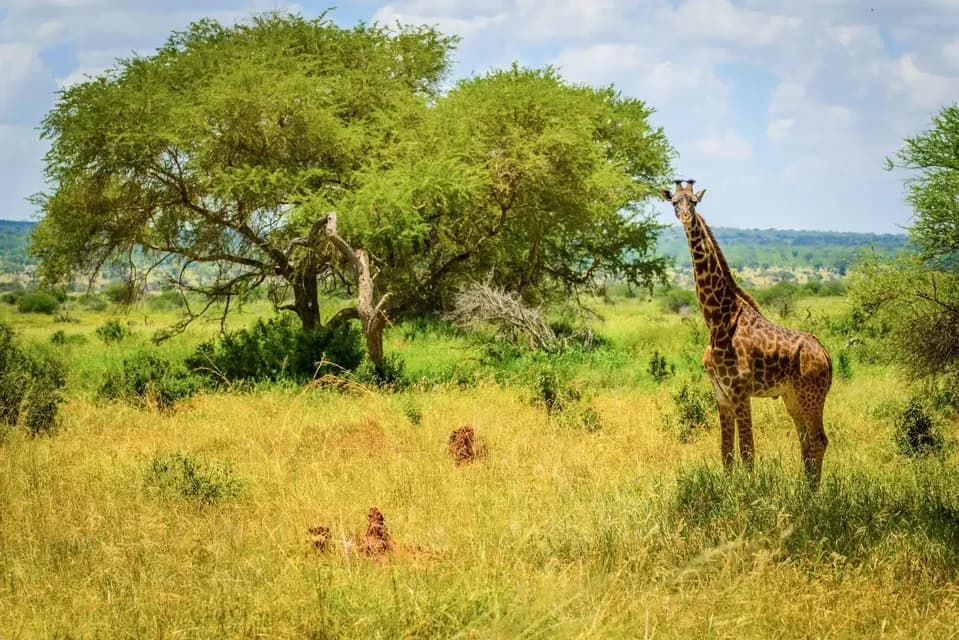
Along the drive, with a bit of luck you could also spot some of the beautiful creatures living in this area, such as zebras, wildebeests, gazelles, buffaloes, giraffes and elephants. Imagine how incredible it would be if on your first day, you were able to see a lion, the king of all animals, or perhaps a cheetah! In this park there is also the largest concentration of baobabs in the country, so get your cameras ready to snap some wonderful pics! In the evening we will arrive in Mto wa Mbu, a Masai village on the shores of Lake Manyara: here you’ll have dinner and then spend the evening in a pub where you can try banana beer.

Lake Manyara and Mto Wa Mbu
Tree climbing lions?
Good morning Africa! This morning we hop back onto the jeeps and head to Lake Manyara National Park for a three hour safari. Which animals do you expect to see today? No doubt we’ll see elephants and giraffes, but if you look closely, you can spot flamingos near the lake and even some lions comfortably sleeping on the branches of the trees: in fact, this park is famous for its tree climbing lions, who retreat amongst the branches to enjoy some shade and escape the heat.
Biking with the locals
We head back to our campsite in Mto wa Mbu for lunch; after recharging our batteries, we’ll ride our bicycles and take a tour of the area with a local guide. As you explore the streets, take your time to discover the typical village houses and stop to have a chat with the locals who will share their customs and traditions - it will be an incredible experience to hear their stories! For dinner, in addition to the ugali, we’ll taste some more typical dishes, like the ndizi nyama, made with green bananas and meat or fish.

Serengeti National Park
The Serengeti grasslands
It’s time to say goodbye to the village of Mto wa Mbu; today will probably be the most exciting day of the whole tour as we enter the vast plains of the Serengeti National Park where, from April to August, nature’s force compels millions of wildebeest and zebras to migrate in search of new, fresh grazing. The prairies are endlessly vast and from the top of Naabi Hill, fingers crossed we might be able to spot imposing herds crossing them: a sight so mesmerising you will be at a loss for words!
Exploring the park
After a short lunch break, our journey continues through the kopjes of Serengeti, particular rock formations which serve as a shelter for the felines of the park - cheetahs, lions, leopards and hyenas. So brace yourself, because this is the spot where you will probably see some of the most beautiful creatures along this tour. Towards the evening we’ll arrive in Seronera, where we will spend the night, perhaps around the bonfire, under Africa’s starry sky.

Serengeti National Park
In search of the big five
It’s a new day inside the park, but today, instead of staying in the Seronera area in the south, we move north, where there won’t be as many tourists. Here we are, in the Mara River area, where the land is dotted with acacia trees and vast open plains. Here, during the months of July and August, it is possible to admire the migration of wildebeests - just like yesterday, nature’s force will take your breath away. So, after two days of safari, we honestly hope that you’ll have seen all of the big five (elephant, lion, leopard, rhino and buffalo)! In the evening we return to our campsite in Seronera: surrounded by this peaceful scenery, the only thing left to do is to look up at the sky and spend another night underneath the stars.

Ngorongoro Conservation Area
We arrive in Ngorongoro
On to more adventures, Ngorongoro here we come! It’s time to say goodbye to Serengeti, our home for the past few days, and head to a new park. Ngorongoro is one of the most incredible places in this part of Africa and the crater alone is worth the trip here. Measuring up to 12 miles wide and covering an area of 100 square miles, the Ngorongoro crater is one of the largest calderas on the planet - lions, spotted hyenas, elephants and black rhinos (an endangered species) wander in the prairies that lie inside it, so get your cameras ready and be ready to click away!
A night under the stars
Ngorongoro is also the home to the Maasai population, who live here and graze their cattle. Hopefully we’ll get to meet them and learn something about their traditions and culture. We’ll then reach our campsite, set up tents and have dinner around the fire, sharing stories about our past and future adventures.

Ngorongoro: another day in the wilderness
In the heart of the crater
Yesterday we saw the crater of Ngorongoro, but today we’ll actually get to go inside it! Everyone says that seeing it from above is one thing, but when you descend inside it, that’s when the real magic happens - it is perhaps one of the major attractions of the African continent and it is in fact a UNESCO World Heritage Site. In the rainy season we will be able to see flamingos resting near Lake Magadi, while in the wide prairies, we will see lions and hyenas hunting for herbivores - wildebeests, zebras, buffaloes and gazelles. After lunch we return to our "base camp" and get ready to sadly leave the park - we’re off to Karatu, a town surrounded by an enchanted landscape, where we’ll stop for the night.

Lake Eyasi and Arusha
Ancient peoples
It’s an early start today; after dismantling the tents and loading everything into our jeeps we head off to Lake Eyasi, one of the favourite destinations in Tanzania for those looking for an experience off the beaten track. The lake's size varies depending on the season and it is not the only attraction of this place: the Hadza tribe lives here, a population that seems to have lived in these lands for about ten thousand years - probably the last real hunters of this part of Africa. We spend the morning discovering their culture and customs - it will be incredible to get in touch with a population so far from our own lifestyle.
Back to Arusha
After lunch we set off and head back to Arusha. Say goodbye to the jeeps, our driver and the tents - tonight (finally!) we’ll sleep a little more comfortably! On the menu for dinner, why not try a few more typical delicacies? A must is definitely nyama choma - the local version of a good barbecue, served with grilled bananas and, of course, ugali!
Arusha
Back to Arusha
It’s the last day in Tanzania, are you already feeling the “Africa Blues”? The day is completely free so we can decide together how to spend it: among the various activities there is a short hike to the top of Suye Hill (it takes about 40 minutes to get to the top) from which to enjoy a unique view of the city. After the hike, we can have a picnic and spend some more time surrounded by nature, making the most of it before we leave! Or perhaps kayaking in Lake Duluti - another great option to consider!
Goodbye Tanzania
Check-out and goodbyes
Check-out and farewell. It is time to say goodbye until your next WeRoad adventure!
What's included
3 nights in shared bedrooms with private bathroom in Arusha
Campsite inside the parks (Ngorongoro and Serengeti) and outside the parks from day 2 to day 7
Entrance fees to Ngorongoro, Serengeti, Tarangire, Lake Manyara National Parks (Around 600$)
Full board (private chef, water and food in tow) from day 2 to day 7
Private Jeep with driver from day 2 to day 8
Medical and baggage insurance - (coverage limits by destination country/region - €10,000 Italy, €20,000 Europe, €30,000 World, €50,000 USA/Canada)
What's not included
Roundtrip flight to/from destination
Food and beverages where not specified
Any souvenirs you're looking to squish into your backpack
- Anything not mentioned in the "What's included" section
Money pot
The Money Pot is approximately £170/€200 for this trip and is collected on-site by the Travel Coordinator on the first day. The amount of the Money Pot will vary based on the number of activities and extras that the group decides to do.
Any local transport in Arusha
The bike excursion to Mto Wa Mbu village with local guide on day 3
Lake Eyasi excursion and cultural tour on day 8
Coordinator’s money pot share
All the extra activities that ALL members of the group agree on doing and the coordinator's fee for doing them as well
Tips for all local service providers who will help make our journey unique. In Tanzania tips make up a large part of the salary locals rely on.
Additional info
- Accommodation
Hotel in Arusha; private and public campsites inside Serengeti National Park and Ngorongoro Conservation Area.
The no-sharing room option is not available for this tour.
The first hotel will be shared with you at least 2 days before your departure by your Travel Coordinator!
- Transport
Jeep and private transfers.
- Staff
Our trips are led by a Travel Coordinator who has been specifically trained by us to lead group travels to ensure you have the best time. A WhatsApp group with all travel participants will be created two weeks prior to departure by your Travel Coordinator.
- Luggage
Backpacks are mandatory to allow easy transfers - we recommend a 45L backpack for our trips.
- Itinerary Seasonality
The itinerary may be subject to variations due to seasonality. In order to provide the best possible travel experience, the itinerary within the parks (especially in the Serengeti) may undergo variations in relation to the patterns of migration of wildlife.
- Private Room Option Show all details
Why WeRoad
-
Small groups, on average 11 people
-
Free cancellation with 100% refund up to 31 days before departure
-
Book with a £/€100 deposit
The travel coordinators
Find your flight
For this trip, we recommend arriving and departing from these airports.
FAQs – Frequently Asked Questions
About this trip
This journey begins at Arusha. On the first day, we meet at 18:00.
Your Coordinator will add you to the WhatsApp group for your trip about 15 days before departure.It’s a great way to start getting to know your travel mates, receive more details about the first day’s meeting point, and ask any pre-departure questions you might have.
We recommend flying to Kilimanjaro, or to Zanzibar and then taking a domestic flight to Arusha.
This journey ends at Arusha. On the last day, you are free to leave at any time, so whether you need to book a flight, a train, or wish to continue the journey on your own, you can organize your return as you prefer.
For this itinerary, traveling with a backpack is mandatory for logistical reasons and the convenience of the entire group - including yourself! Trolleys, bulky suitcases, or hard luggage are not allowed. The Travel Coordinator will provide guidance on the ideal baggage before departure via the WhatsApp group.
About Tanzania
If you are a UK citizen, to find out the entry requirements for Tanzania, you can check this informational page from our partner Sherpa. If you need a visa, you can apply for it through Sherpa. If you are not a UK citizen, you can still use Sherpa by changing the nationality in the 'Passport' section.
Before traveling, always remember to check the government website of your country of origin for updates on the entry requirements for Tanzania – you wouldn’t want to stay home due to a bureaucratic detail!
- UK residents: review the FCDO Travel Advice.
- US residents: consult the US Department of State Travel Advice.
- Other residents: refer to your government or local consulate's travel advice.
Tanzania is in the East Africa Time zone, which is UTC+3. This means that if it is 12pm in the UK, it will be 3pm in Tanzania. If you are in the USA, the time difference will vary depending on your location. For example, if it is 12pm Eastern Time, it will be 7pm in Tanzania. Tanzania does not observe daylight saving time, so these differences remain constant throughout the year.
The currency used in Tanzania is the Tanzanian Shilling (TZS). The exchange rate can vary, but as of the latest update:
- 1 GBP is approximately 3,100 TZS
- 1 USD is around 2,300 TZS
- 1 EUR is about 2,600 TZS
You can exchange currency at banks, exchange bureaus, or major hotels in cities like Dar es Salaam and Arusha. It's a good idea to carry some cash, especially in rural areas where card payments might not be accepted.
In Tanzania, you can pay using cash, credit cards, and mobile payment platforms.
- Cash is king, and the local currency is the Tanzanian Shilling.
- Credit cards are widely accepted in major cities and tourist areas, but not everywhere, so it's a good idea to have some cash on hand.
- Mobile payment services like M-Pesa are also popular and convenient for smaller transactions.
Make sure to check with your bank about any international transaction fees before traveling.
In Tanzania, tipping is not mandatory, but it's appreciated for good service. In restaurants, consider leaving about 5 to 10 percent of the bill as a tip. For guides or safari drivers, a tip of around 10 to 20 USD per day is common. Hotel staff, like porters or housekeeping, will appreciate a small tip, such as 1 to 2 USD. Always tip in Tanzanian Shillings or USD, and give tips directly to the person who helped you.
In Tanzania, Wi-Fi is generally available in hotels, cafes, and some public places in major cities like Dar es Salaam and Arusha. However, the connection can be slow or unreliable, especially in rural areas. For better connectivity, we suggest you buy a local SIM card or an e-SIM data plan. Popular providers include:
- Vodacom
- Airtel
- Tigo
You can purchase these at the airport or in the city, and they offer good coverage and data packages at reasonable prices.
In Tanzania, the official languages are Swahili and English. You'll hear Swahili spoken widely, and it's handy to know a few basic phrases. Here are some useful expressions you might hear or use:
- Hello: Jambo
- Thank you: Asante
- How much is this?: Hii ni kiasi gani?
- Goodbye: Kwaheri
Don't worry if you're not fluent, as many people also speak English, especially in tourist areas.
In Tanzania, the power plugs and sockets are of type D and G. The standard voltage is 230 volts, and the frequency is 50 hertz. If you're coming from a country with different plug types, like those used in the UK or the USA, it's a good idea to bring a universal adapter to ensure your devices can be charged without any issues.
In Tanzania, the main religion is Christianity, followed by Islam. It's important to note that Zanzibar, a semi-autonomous region of Tanzania, has a predominantly Muslim population. If visiting Zanzibar, especially during the holy month of Ramadan, it's respectful to dress modestly. For women, this means covering shoulders and knees. Important religious holidays include Eid al-Fitr and Eid al-Adha for Muslims, and Christmas and Easter for Christians.
For a trip to Tanzania, pack light and suitable items for the tropical climate and diverse landscapes. Here's a list to help you prepare your backpack:
-
Clothing:
- Lightweight shirts and t-shirts
- Long-sleeve shirts for sun and mosquito protection
- Shorts and lightweight pants
- A light jacket for cooler evenings
- Swimwear
-
Shoes:
- Comfortable walking shoes
- Sandals
- Flip-flops for the beach
-
Accessories and Technology:
- Sunglasses and a wide-brimmed hat
- Camera and charger
- Power bank
- Plug adapter (Tanzania uses types D and G plugs)
-
Toiletries and Medication:
- Sunscreen and insect repellent
- Basic toiletries
- Hand sanitizer
- Common travel medication like motion sickness tablets, pain relievers, and anti-diarrheal pills
Remember that Tanzania is a predominantly Muslim country, so dress modestly in public areas, especially women, to respect local customs.
The weather in Tanzania varies by region, so here's a quick breakdown:
- Coastal areas (like Dar es Salaam and Zanzibar): Warm and humid year-round with temperatures ranging from 25°C to 32°C (77°F to 90°F). The best time to visit is during the dry season, from June to October.
- Northern and central regions (like Serengeti and Arusha): Cooler and drier, especially from June to October, with temperatures around 15°C to 25°C (59°F to 77°F). The short rainy season is from November to December, and the long rainy season is from March to May.
- Western areas (like Kigoma): Warm and can be quite humid. The best time to visit is the dry season, from May to October.
For the best experience, plan your visit during the dry season when the weather is most pleasant and wildlife viewing is optimal.
About WeRoad
Return international flights are not included on our trips because we want to give you full autonomy and flexibility. You can choose your preferred airline, fly from the airport that works best for you, and decide how many stopovers you want to make along the way.
As flights are not included, you also have more flexibility with your travel dates: you could arrive at your destination a few days early or return home a bit later – or even continue independently to a nearby destination!
An "Available" departure means that the trip isn’t confirmed yet and we’re waiting for a few more travellers to sign up… which could be you!
If you book the trip please wait for it to be confirmed before booking your international flights.
The question of all questions! Here’s some more information:
- The Money Pot is a common fund collected in local currency from all travellers on the trip and managed by your Travel Coordinator.
- It is used to streamline payments for extra activities, goods and services that the whole group decides to do. This guarantees flexibility in choosing activities and excursions at the destination in line with the mood of the group.
- It is typically collected on the first day of the trip in local currency, although at times, the Travel Coordinator may ask for it to be paid before departure.
- You’ll find the Money Pot amount on the website under the section ‘What’s included in the Money Pot’. To find this look for ‘What’s included’, scroll down to ‘Money Pot? Click here’ and you’ll find the details.
- The amount varies depending on the destination chosen.
- It is usually used for group expenses that all travellers decide to take part in, but sometimes if you opt out of an activity it might make more sense for it to come out of the Money Pot. In these cases the Coordinator will return the amount for this activity back to you at the end of the trip.
- It is estimated based on the experience of other groups but can vary depending on what activities your group is keen for. As such, the Travel Coordinator may need to increase the amount during the trip.
- If not all of the Money Pot is spent, the difference will be returned to all travellers at the end of the trip.
- The Money Pot also covers the Travel Coordinator’s share of the activities included in the Money Pot, except for those activities that are free for the Travel Coordinator.
- If you pay in advance for part of the Money Pot before the trip for certain non-refundable optional activities, unfortunately, the amount cannot be refunded if the trip is cancelled.
We offer several payment methods to fit every need:
1. Credit or debit card (Visa, Mastercard, American Express);
2. Instalment payment with Klarna (you’ll pay for the trip in three equal amounts);
3. PayPal (for selected destinations);
4. Revolut Pay to pay even faster straight from your Revolut account.
Anyone who books a WeRoad trip has the option to cancel or modify the trip – including both the dates and the destination – free of charge up to 31 days before departure. In case of cancellation up to 31 days before departure, you will receive a 100% refund of the WeRoad trip price. If you make a change, a price adjustment will be applied to the new trip chosen – meaning, if the new trip is cheaper, we will refund the difference; if it’s more expensive, you will need to pay the difference.
If you’ve purchased the Flexible Cancellation Option (which you can add in the first step of the booking process), you can request a cancellation or trip change until 8 days before departure. In case of cancellation, you’ll receive a 100% refund of the WeRoad trip price, minus the cost of the Flexible Cancellation option.
How to request a cancellation or change to your trip? Send us an email at [email protected] or a WhatsApp on +447716573700. Please share the booking reference for the trip you want to cancel or change, and, in case of a change, the new trip you would like to join.
For our trips we usually use locally owned accommodation instead of big hotel chains. It’s our favourite way to really experience the local culture and, whenever we can, support the local economy. Typically, you’ll stay in hotels, apartments, guesthouses and hostels with the same standard maintained across all trips in the same destination.
The list of accommodation for your trip will be shared with you by your Travel Coordinator 2-5 days before departure, along with other useful details for your adventure!
Yes! We might not know the flights for everyone else in the group, but there are ways to find out which flights your fellow WeRoaders will be taking.
1. All travellers can share their flight details after booking on their My WeRoad account so that other travellers on the same trip can see these details anonymously.
2. Alternatively you can join our Facebook group: Solo Travellers | WeRoad Community – (here is the extended link: https://www.facebook.com/groups/963298767843213 ) Look for a post about the trip you’re interested in or ask the group admin for help in getting in touch with your future travel companions!
3. If the Coordinator has already been assigned to the trip you’re keen for, you can easily find their Facebook post on the website. Click 'Ask the Coordinator' and follow the link here.
Our groups usually consist of 8–12 travellers, with a minimum of 3–4 and a maximum of 15.
Everyone on our trips speaks English, and travellers join us from across the UK, Europe and beyond. Our trips are open to people in their 20s, 30s, and 40s, with an average age of 34 across all trips.
Each group will be joined and led by one of our experienced Travel Coordinators, who’s there to ensure everything runs smoothly and the group feels well-supported.
If you’d like to know more about our typical WeRoad groups do reach out to us on WhatsApp on +44 7716573700.
Yes! If you're curious, you can take a sneak peek at the group before booking.
You’ll find the info in the ‘Group’ section for each trip on the departures page, showing how many WeRoaders have already booked.
Click the little arrow and you’ll even see their gender and ages – but hey, that’s exclusive info, so we’ll ask you to log in or sign up to see that!
For some trips, in the itinerary section, you’ll find the number of nights and the location (not the hotel) where you’ll be spending the night(s). The location shown is the one we usually go for on most trips, but in some cases, you might stay in a nearby town. This will depend on logistics or availability of accommodation.
The list of accommodation for your trip (and therefore also the exact locations) will be shared by your Travel Coordinator 2-5 days before departure, along with other useful information for your adventure!
The WeRoad Travel Coordinator is an experienced and skilled traveller who will be the perfect companion for your trip. They will manage all the logistical aspects of the itinerary like transport, timings, accommodation, restaurant bookings and meeting points, so that you can enjoy the trip without this hassle. They’re there to support the group, ensure everything runs smoothly and will no doubt make the trip a lot of fun along the way too!
The Coordinator will set up a WhatsApp group approximately 2 weeks before departure. This will be the moment to ask any pre-departure questions and get to know the rest of the group! If the trip you are interested in already has a Travel Coordinator assigned, you can contact them before booking. Their details will be on the trip page, or you can search for their name here. After booking, you will find their contact details in your My WeRoad account, under ‘Bookings and Trips’ > ‘Your Upcoming Trips’ > ‘Trip Details’.
Yes, on all our trips you will share a room with other WeRoaders in your group. By default this will be people of the same gender, unless you tick ‘I'm OK with a mixed gender room’ when you book. The bathroom will either be private or shared only with other travellers on the trip. The rooms might be twins, triples, quadruples or multi-share (up to 8 people in exceptional cases), depending on the destination and availability.
You will never share with people from outside of the WeRoad group, except in certain cases for local experiences, which are specifically mentioned in the itinerary or communicated before booking. These typically involve specific nights in unique accommodation like tents, homestays, or camping, offering a more adventurous travel experience in exchange for some comfort.
On some of our trips we can offer a private room for an additional cost. Just tick the ‘Private Room’ option at checkout to get this added. For some of our trips if you book as two travellers together you can add this private room free of charge. Look out for this option at checkout.
Please note that if you do book a private room with a friend/partner this could be either a double or a twin room so please email [email protected] if you have a preference on this.
When you set off on a WeRoad trip, you’re officially a WeRoader – and as we often say, 'once a WeRoader, always a WeRoader'. This means that once you’re part of the community, a little piece of WeRoad will always stay with you.
But you’re not just a WeRoader during your trips, far from it! The community is alive and active all year round: you can stay in touch by following and interacting on our social media channels, like the Facebook group or the Instagram profile. You can also come along to one of our many events that we run in different cities worldwide. Check out and sign up to our events by downloading the WeMeet app here.