

Is this trip for me?
Party and nightlife
Relax
Nature and adventure
City and cultures
Monuments and history
Physical effort
Trip type
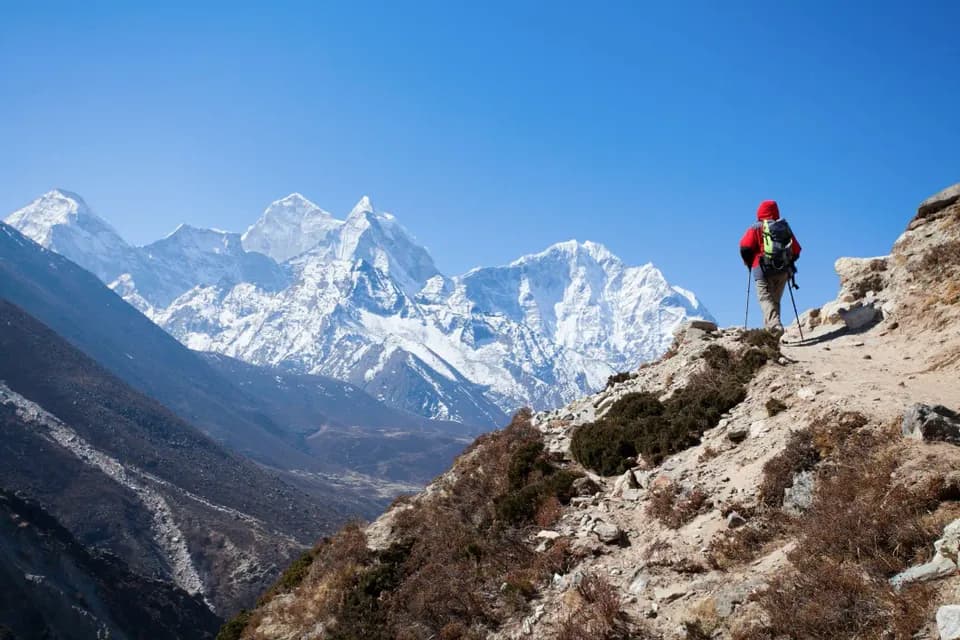
A journey to every hiker's Mecca. A trek that will take us to the 5,364-meter Base Camp of the peak most dreamed of by all mountain lovers. On the border between Nepal and Tibet, surrounded by the majestic scenery of the Himalayas and their most coveted peak, Mount Everest.
On this 14-day itinerary, we'll cover many kilometers on trails that pass through ancient Buddhist monasteries, golden temples, and small villages of local people who will introduce us to true Nepalese hospitality. We'll always be accompanied by two expert Sherpas and a porter who, along with our own legs, will guide us each day toward our long-desired shared goal.
Sharing this goal with a group of mountain enthusiasts like you will make this experience even more unforgettable!


We can head out for a first wander around the city. Kathmandu is part of a wider urban sprawl made up of three historic centres: Kathmandu, Patan, and Bhaktapur.
Despite the damage caused by the 2015 earthquake, the historic heart of Kathmandu is still an open-air museum of striking temples and pagodas. We make our way to Durbar Square, the city’s most iconic plaza, framed by grand palaces and temples. Here you’ll find the former royal residence, Hanuman Dhoka, where Nepalese kings were crowned until 2001.
After the city tour, we head back to Thamel, a lively neighbourhood packed with trekking shops, bars, and restaurants to suit every taste. It’s the perfect moment for any last-minute gear shopping before the days of trekking ahead.
We wrap up the day with our first group dinner, diving straight into Nepalese flavours. Dal Baht or Momo? Don’t worry if they’re unfamiliar now — you’ll be seeing (and eating!) plenty of them throughout the trip.

We wake up early, meet our Sherpa who will accompany us for the next few days and head to Manthali to take the internal flight to Lukla , the starting point from which our trek begins.
After a short 20-minute flight over lush hills and rising peaks, we land at Tenzing Hillary Airport in Lukla. Here we meet our second guide and our porter before setting off on the first stretch of our trek towards Phakding.
Trekking duration: 3–4 hours Distance: 7 km Ascent: ↑100 m Descent: ↓250 m
After a hearty breakfast, we'll begin the actual trek. The route will gradually level out until Monjo (2.5 hours). From Benkar, we'll get our first glimpse of Mount Thamserku. At Monjo, we'll enter Sagarmantha National Park .
After lunch in Jorsalle, we'll continue trekking, crossing several Tibetan bridges . After the last bridge before Namche , the trail will begin to climb. If we're lucky with good weather, we'll be able to admire his majesty, Mount Everest, from Larja Doban!
Trekking duration: 6-7 hours
Length: 9 km
Elevation gain: ↑960m
Negative difference in altitude: ↓130m
In the morning we will take a short 10-15 minute walk to the Everest viewpoint at the national park headquarters, where you can admire the sunrise , the view of Everest, Lhotse, Lhotse Shar, Nupse Shar, Amadablam, Thamserku, Kusum Kang karu, Kondge Range.
After sunrise, we'll descend to the hotel for breakfast. Afterwards, it's best to stay active to acclimatize to the altitude: we can head to the Everest View Hotel (3,880 m) and descend to Khumjung before returning to Namche. On the way back up, we'll visit the Syangboche landing area and Everest Nest, where we can see an exhibition on waste recycling in the Khumbu Valley. Namche is one of the largest centers in the Khumbu Valley, offering numerous opportunities for relaxation in cafes, restaurants, bars, shops, bakeries, and more.
Trekking duration: 4 hours of excursion followed by half a day of rest and relaxation.
Elevation gain: Approximately 500m of ascent and descent to return to the lodge.
After breakfast, our trek to Sanasa is relatively flat. This is an easy three-hour trek, offering good views of mountains such as Mount Everest, Mount Lhotse , Lhotse Shar, Nupse Shar, Mount Amadablam, Mount Thamserku, Kusum Kang Karu, the Phortse Valley, and Tengboche Monastery . From Sanasa, we descend to Phugi Tanga, where we stop for lunch before ascending to Tenboche.
After a 2.5-hour trek, the trail will lead us to Tengboche Monastery. After visiting the monastery, we'll continue for another 1.5 hours to Pangboche, through a beautiful rhododendron forest.
Trekking duration: 8-9 hours
Length: 13 km
Elevation gain: ↑920m
Negative altitude difference: ↓400m
Today we head to Dingboche, a village with numerous yak pastures and potato fields, located in a wide, windswept valley at the foot of Mount Ama Dablam.
We will have a close-up view of Mount Ama Dablam and Island Peak , all part of the Himalayan massif.
Trekking duration: 3-4 hours
Length: 6.5 km
Elevation gain: ↑720m
Negative difference in altitude: ↓150m
After crossing a small ridge near Dingboche , the trail gradually climbs towards Thukla, where we have lunch before continuing.
Along the way, we'll continue to be surrounded by beautiful mountains and green valleys. We'll also have a good view of Mount Lobuche. At Thukla Pass, there's a memorial dedicated to climbers who died in the mountains, and from here, the trail gradually flattens out with sweeping views of mountains such as Pumori, Lingtren, and Nupse .
Trekking duration: 5-6 hours
Length: 8 km
Elevation gain: ↑700m
Negative difference in altitude: ↓70m
We depart early from Lobuche for a trek along the western flank of the vast Khumbu Glacier, through meadows and sacred slopes. The trail is somewhat rugged , and it's important to trek slowly, as this is our first time above 5,000 meters. Enjoying the panoramic views of the surrounding mountains, we cross the Lobuche Pass, where our glacier trek begins. Crossing the glacier, we reach a small settlement at 5,140 meters called Gorak Shep . After lunch and checking into the lodge, where we can leave most of our packs, we hike to Everest Base Camp at 5,364 meters, a further 2-3 hours' walk.
We've reached the highest point of our journey, and that's why we set out! The excitement will be palpable, one we'll share fully with our group of new friends. We'll stop to savor the moment and take some photos before continuing our journey back to Gorak Sherp for the night.
Trekking duration: 5-6 hours
Length: 9 km
Elevation gain: ↑750m
Negative difference in altitude: ↓450m
Early this morning, we'll take an optional two-hour hike to Kalapathar (5,545 m) to watch the sunrise from a breathtaking vantage point. After admiring Mount Everest and the surrounding mountains, we'll descend to the lodge for breakfast and prepare to descend to Pangboche via Lobuche-Pheriche.
Trekking duration: 8-9 hours
Length: 13 km
Positive difference in altitude: ↑150m
Negative altitude difference: ↓1200m
On the way back to Namche we can relax and enjoy the view of Kwongde Peak in front of us and Thamserku and Kangtega to our left.
From Tengboche, the trail descends steeply to the river at Pungi Tanga. The route then climbs again to pass through Sanasa and gradually reach our destination for the night, Namche Bazar.
Here we will have the opportunity to recover some of the energy spent these days.
Trekking duration: 8-9 hours
Length: 13 km
Elevation gain: ↑400m
Negative difference in altitude: ↓920m
Today, as the last day of trekking, we return to Lukla via Monjo-Phakding on an easy but rather long route.
Upon arrival in Lukla , check into the lodge and relax in the village where we will have the opportunity to celebrate our feat properly!
In the morning, our return flight awaits us. We land in Manthali, and from there, the bus will take us back to Kathmandu. After checking into the hotel, we could organize a visit to Bhaktapur, one of the three royal cities, about 30 minutes from the capital. Among the things to see, the most fascinating remain its stupas, ancient temples, and Durbar Square , the true heart of the city.
Upon returning, you'll have free time to explore the city, perhaps visiting one of the many massage parlors to help you recover from the exertions of the trek.
NB In case of bad weather or unforeseen events, this is to be considered a "buffer" day to ensure that the itinerary can be carried out without problems and that there are no difficulties returning to Kathmandu, from where everyone will then have to take flights back to Italy.
We can dedicate this day entirely to exploring the city of Kathmandu, with the help of a local guide. The unmissable stops are: Patan Durbar Square, one of the three Durbar squares in the Kathmandu Valley, famous for the palaces surrounding it; Swayambhunath , an ancient Buddhist religious complex located atop a hill in the Kathmandu Valley, famous for its numerous monkeys; Boudhanath Stupa, the stupa of Buddha's enlightenment; and Pashupati Temple , the most important Hindu temple in Nepal.
Immersed in Nepalese culture and people, we'll have the opportunity to do some last-minute shopping and enjoy a final dinner together, where we'll recount and share the emotions of these memorable days. And why not, have some fun at one of the city's clubs with music and karaoke!

It's time to say goodbye. See you at the next WeRoad!

3 nights in a hotel in double or triple rooms with private bathroom

10 nights in typical Nepalese guesthouses during the trek

Domestic flights to/from Lukla on days 2 and 12

Transfer Kathmandu - Airport and vice versa on days 2 and 12

All breakfasts
 Medical and baggage insurance - (coverage limits by destination country/region - €10,000 Italy, €20,000 Europe, €30,000 World, €50,000 USA/Canada)
meals and drinks unless indicated
all the extras you want to buy and can fit in your backpack :)
The Money Pot is approximately £130/€150 for this trip and is collected on-site by the Travel Coordinator on the first day. The amount of the Money Pot will vary based on the number of activities and extras that the group decides to do. Any unused balance at the end of the trip will be refunded.
Tips to local guides and or other services
Any transportation in the Kathmandu area
The activities and extras that all participants have agreed to do and the coordinator's share of the cost
During the trek, we'll stay in guesthouses with shared rooms. Hot water and private bathrooms are not guaranteed.
The private room option is not available for this trip.

In the case of bad weather, for safety reasons, the flight routes will be replaced by car transfers, therefore the itinerary will undergo the following changes:
In case of bad weather on day 2, the trek will start on day 3 instead of day 2 and, consequently, the return flight will be scheduled for day 13 instead of day 12
In case of bad weather on day 12, you will return to Kathmandu by car on day 13 instead of day 12
In case of bad weather on both day 2 and day 12, you will arrive in Kathmandu by car on the morning of day 14

Why WeRoad
Small groups, on average 11 people
Move or change your trip for free up to 31 days before departure
Book with €/£/$0. Pay the €/£/$100 deposit only once the trip is confirmed
Find your flight
For this trip, we recommend arriving and departing from these airports.

This is a WeRoadX
A trip designed and created entirely by an experienced WeRoad Travel Group Leader.
This is a trip designed and created entirely by an experienced WeRoad Travel Group Leader. They organise the whole trip: from defining the itinerary to selecting accommodation and on-site experiences. On the WeRoad website you can book the trip and manage it in MyWeRoad, just like any other WeRoad.
This trip starts in Kathmandu. On the first day, we’ll meet at 18:00.
Your Group Leader will add you to the WhatsApp group for your trip about 15 days before departure.
It’s a great way to start getting to know your travel mates, receive more details about the first day’s meeting point, and ask any pre-departure questions you might have.
This trip ends in Kathmandu. The trip officially ends at 14:00 on the last day, so we recommend planning your return transfers accordingly. For example:
If you have any doubts, you can contact the coordinator assigned to your departure for advice.
This trip includes two days of trekking; you’ll find all the details in the day-by-day itinerary.
For this itinerary, soft luggage is required for logistical reasons and the convenience of the whole group - including yourself! Soft luggage includes backpacks, duffel bags, or sports bags, but not trolleys or bulky suitcases. The Travel Group Leader will provide guidance on the ideal baggage before departure via the WhatsApp group.
Find out the entry requirements for Nepal, and, if needed, apply for your visa through our partner Sherpa.
Before traveling, always remember to check the government website of your country of origin for updates on the entry requirements for Nepal – you wouldn’t want to stay home due to a bureaucratic detail!
Nepal is in the Nepal Time Zone, which is 5 hours and 45 minutes ahead of Greenwich Mean Time (GMT+5:45). If it is 12pm in the UK, it will be 5:45pm in Nepal. If it is 12pm in New York, USA, it will be 10:45pm in Nepal. Keep in mind that Nepal does not observe daylight saving time, so the time difference remains constant throughout the year.
Nepal uses the Nepalese Rupee (NPR) as its currency. The daily exchange rate can vary, but you might expect approximately:
Currency can be exchanged at banks, authorized money changers, and some hotels. Always make sure to get a receipt for any currency exchange you make.
You'll find that in Nepal, you can pay using cash, credit cards, and mobile payment apps. Cash is widely accepted, especially in smaller towns and rural areas, so it's handy to keep some Nepali rupees on you. Major credit cards like Visa and MasterCard are accepted in most hotels, restaurants, and shops in larger cities like Kathmandu and Pokhara, but it's good to double-check before making a purchase. For a more seamless experience, you might also consider using mobile payment services that are gaining popularity, such as eSewa or Khalti.
Tipping in Nepal is not mandatory, but it's appreciated, especially in the tourism industry. In restaurants, you can leave around 10 percent of the bill if a service charge isn't included. For guides and porters, tipping is customary and expected, usually at the end of a trek or tour. Consider tipping guides around 10 percent of the tour cost and porters a bit less. In taxis, rounding up the fare is common. Remember, tips are an important part of income for many workers in Nepal.
In Nepal, internet access can be a bit spotty, especially in rural areas. While Wi-Fi is commonly available in hotels, cafes, and restaurants in cities like Kathmandu and Pokhara, the speed can vary. For more reliable internet access while traveling around, we recommend you buy a local SIM card or an e-SIM data plan. Major providers include Ncell and Nepal Telecom, and you can purchase SIM cards at the airport or local shops. This will help ensure you stay connected even in more remote areas.
Nepal's official language is Nepali. It's widely spoken across the country, but you'll also find a variety of other languages, especially in different regions and among various ethnic groups. Here are some useful Nepali expressions you might hear or use:
Having a few basic phrases can help in getting around and interacting with locals.
In Nepal, the standard voltage is 230 V and the frequency is 50 Hz. The plugs used are mostly Type C, D, and M. Since these are different from those used in many European countries and the USA, we suggest bringing a universal adapter to ensure your devices can be charged without any hiccups.
The main religion in Nepal is Hinduism, with a significant portion of the population practicing it. Important religious holidays include:
While Hinduism is predominant, there are also communities practicing Buddhism, Islam, and Christianity in the country.
Packing for Nepal can be quite an adventure due to its diverse climate and terrain. Here's a handy guide to help you prepare your backpack:
This list should cover the essentials for your trip to Nepal, keeping you prepared for both trekking and city exploration.
Nepal's weather varies significantly by region and altitude, so here's a quick breakdown:
Overall, Nepal has a monsoon season from June to September, so if you're not a fan of rain, you might want to avoid visiting during these months.
Return international flights are not included on our trips because we want to give you full autonomy and flexibility. You can choose your preferred airline, fly from the airport that works best for you, and decide how many stopovers you want to make along the way.
As flights are not included, you also have more flexibility with your travel dates: you could arrive at your destination a few days early or return home a bit later – or even continue independently to a nearby destination!
It depends on when you cancel, the status of your departure, and how much you have already paid. Here are all the cases.
If you cancel more than 31 days before departure - Departure not confirmed
You can cancel via email at hello@weroad.com
If it was your first unconfirmed booking (if you have more than one), nothing has been charged: no refund is needed.
If you paid the €/£/$100 deposit, it will be fully refunded.
Departure confirmed – you paid only the €/£/$100 deposit
In case of cancellation by the WeRoader, the deposit paid is not refunded. However, you can change your trip from your MyWeRoad Account and use the amount for another departure.
Departure confirmed – you paid the full amount
In case of cancellation by the WeRoader, the amount paid is not refunded. However, you can change your trip from your MyWeRoad Area and use the amount for another departure.
If you cancel less than 31 days of departure
You can cancel your booking at any time. However, in case of cancellation of less than 31 days before departure, no refund of the amount paid is provided, nor is it possible to change your trip, unless you have purchased Flexible Cancellation.
The private room fee, included in the price of your trip, is not refunded under any circumstances within this time frame, unless you have purchased Flexible Cancellation.
If you have Flexible Cancellation
With Flexible Cancellation, you can cancel up to 8 days before departure and receive a 100% refund of the price, including the deposit and the private room fee. The only amount not refunded is the cost of the Flexible Cancellation option itself.
PLEASE NOTE: before cancelling, keep in mind that you can move your booking to another trip or a different date. Find out how!
For any doubts about your specific situation, write to our team at hello@weroad.com - we’ll help you!
Yes, you can change your trip directly from your MyWeRoad personal area, up to 31 days before departure. If you purchased Flexible Cancellation, you have up to 8 days before departure.
How to change your trip from MyWeRoad
Things to know
You can change your trip up to 3 times from your MyWeRoad personal area. Further changes must be requested by contacting our team at hello@weroad.com.
The new trip must depart within 12 months from the original departure date.
If your original booking included a private room, Flexible Cancellation, discount codes, gift cards, or vouchers, we will notify you before confirmation if they cannot be applied to the new trip.
You cannot switch to sold-out trips. For “On request” departures, we will check availability. For “Last spots” departures, availability in rooms of your same gender may not be guaranteed.
If there is a price adjustment: if the new trip costs less, we will refund the difference; if it costs more, you will need to pay the difference.
PLEASE NOTE: before cancelling, keep in mind that you can move your booking to another trip or a different date. Find out how!
In some cases – for example when a departure is not yet confirmed and it is your first unconfirmed booking – you can book without paying the €/£/$100 deposit upfront.
This means that you can secure your spot at zero cost: nothing will be charged until the departure is confirmed. Once the departure is confirmed, the €/£/$100 deposit will be automatically charged within 48 hours according to the terms agreed at the time of booking.
If a departure is “Available”, it means that the trip is not yet confirmed and we are waiting for a few more bookings… maybe yours!
The good news? If it’s your first booking on an unconfirmed departure, you can book without paying anything! Just. leave your credit card details as a guarantee: no immediate charge, €/£/$0 deposit.
In the meantime, wait for the departure to be confirmed before purchasing your round-trip flights!
The question of all questions! Here’s some more information:
Yes, but the available options depend on the status of your trip and when you make the request.
If your trip is not yet confirmed
You can cancel your booking by emailing hello@weroad.com
free of charge, up to 31 days before departure.
Please note: if it’s your first unconfirmed booking, you will only be asked to provide a credit card, PayPal, or Revolut as a guarantee, but nothing will be charged. From the second unconfirmed booking onwards, a mandatory £/$0100 deposit will be required.
If your trip is confirmed
Fees are not refundable in cash. You are entitled to cancel up to 31 days before departure, but after this deadline, cancellation is no longer possible.
Flexible Cancellation
If you purchased the Flexible Cancellation option (available in the first step of the booking process), you can cancel your trip up to 8 days before departure and receive a 100% refund of the price, including the deposit and private room fee. The only non-refundable amount is the cost of the Flexible Cancellation option itself.
How to cancel your trip
PLEASE NOTE: before cancelling, keep in mind that you can move your booking to another trip or a different date. Find out how!
For our trips we usually use locally owned accommodation instead of big hotel chains. It’s our favourite way to really experience the local culture and, whenever we can, support the local economy. Typically, you’ll stay in hotels, apartments, guesthouses and hostels with the same standard maintained across all trips in the same destination.
The list of accommodation for your trip will be shared with you by your Travel Coordinator 2-5 days before departure, along with other useful details for your adventure!
We offer several payment methods to fit every need:
1. Credit or debit card (Visa, Mastercard, American Express);
2. Instalment payment with Klarna (you’ll pay for the trip in three equal amounts);
3. PayPal (for selected destinations);
4. Revolut Pay to pay even faster straight from your Revolut account.
Yes! We might not know the flights for everyone else in the group, but there are ways to find out which flights your fellow WeRoaders will be taking.
1. All travellers can share their flight details after booking on their My WeRoad account so that other travellers on the same trip can see these details anonymously.
2. Alternatively you can join our Facebook group: Solo Travellers | WeRoad Community – (here is the extended link: https://www.facebook.com/groups/963298767843213 ) Look for a post about the trip you’re interested in or ask the group admin for help in getting in touch with your future travel companions!
3. If the Group Leader has already been assigned to the trip you’re keen for, you can easily find their Facebook post on the website.
Generally, our groups have an average of 11 people. Everyone on our trips speaks English, and travellers join us from across the UK, Europe and beyond. Our trips are open to travelers between 25 and 49 years old. The indicated age is meant to give you an idea of the type of group, but it's not a strict limit: it's possible to participate even with a few years more or less, as long as you can keep up with the pace and energy of the group you're traveling with.
Each group will be joined and led by one of our experienced Travel Coordinators, who’s there to ensure everything runs smoothly and the group feels well-supported.
If you’d like to know more about our typical WeRoad groups do reach out to us on WhatsApp on +44 7716573700.
Yes! If you're curious, you can take a sneak peek at the group before booking.
You’ll find the info in the ‘Group’ section for each trip on the departures page, showing how many WeRoaders have already booked.
Click the little arrow and you’ll even see their gender and ages – but hey, that’s exclusive info, so we’ll ask you to log in or sign up to see that!
For some trips, in the itinerary section, you’ll find the number of nights and the location (not the hotel) where you’ll be spending the night(s). The location shown is the one we usually go for on most trips, but in some cases, you might stay in a nearby town. This will depend on logistics or availability of accommodation.
The list of accommodation for your trip (and therefore also the exact locations) will be shared by your Travel Group Leader 2-5 days before departure, along with other useful information for your adventure!
The WeRoad Travel Group Leader is an experienced and skilled traveller who will be the perfect companion for your trip. They will manage all the logistical aspects of the itinerary like transport, timings, accommodation, restaurant bookings and meeting points, so that you can enjoy the trip without this hassle. They’re there to support the group, ensure everything runs smoothly and will no doubt make the trip a lot of fun along the way too!
The Group Leader will set up a WhatsApp group approximately 2 weeks before departure. This will be the moment to ask any pre-departure questions and get to know the rest of the group! If the trip you are interested in already has a Travel Group Leader assigned, you can contact them before booking. Their details will be on the trip page, or you can search for their name here. After booking, you will find their contact details in your My WeRoad account, under ‘Bookings and Trips’ > ‘Your Upcoming Trips’ > ‘Trip Details’.
Yes, on all our trips you will share a room with other WeRoaders in your group. By default this will be people of the same gender, unless you tick ‘I'm OK with a mixed gender room’ when you book. The bathroom will either be private or shared only with other travellers on the trip. The rooms might be twins, triples, quadruples or multi-share (up to 8 people in exceptional cases), depending on the destination and availability.
You will never share with people from outside of the WeRoad group, except in certain cases for local experiences, which are specifically mentioned in the itinerary or communicated before booking. These typically involve specific nights in unique accommodation like tents, homestays, or camping, offering a more adventurous travel experience in exchange for some comfort.
On some of our trips we can offer a private room for an additional cost. Just tick the ‘Private Room’ option at checkout to get this added. For some of our trips if you book as two travellers together you can add this private room free of charge. Look out for this option at checkout.
Please note that if you do book a private room with a friend/partner this could be either a double or a twin room so please email hello@weroad.com if you have a preference on this.
When you set off on a WeRoad trip, you’re officially a WeRoader – and as we often say, 'once a WeRoader, always a WeRoader'. This means that once you’re part of the community, a little piece of WeRoad will always stay with you.
But you’re not just a WeRoader during your trips, far from it! The community is alive and active all year round: you can stay in touch by following and interacting on our social media channels, like the Facebook group or the Instagram profile. You can also come along to one of our many events that we run in different cities worldwide. Check out and sign up to our events by downloading the WeMeet app here.