From the savanna to the red deserts of Sossusvlei: in Namibia, you sleep under the stars, meet the Big Five in Etosha, and toast in Swakopmund. Between dunes, safaris, and ice-cold beers, you’ll discover the Africa few see but everyone falls in love with.

Is this trip for me?

Party and nightlife
Relax
Nature and adventure
City and cultures
Monuments and history
Physical effort
Trip type

Itinerary

Africa remains one of the last great frontiers of adventure, and nowhere is this truer than in the stunning landscapes of Namibia. Between its endless savannahs and towering red sand dunes, you’ll feel like you’ve landed on another planet, where Mother Nature reigns supreme.

Our journey begins in the captivating city of Windhoek, but we won’t stay long—we’ll head north to explore the Cheetah Conservation Fund, where we’ll encounter majestic cheetahs for the first time. Next, we’ll venture into Etosha National Park, where lions, zebras, elephants, and giraffes roam freely.

From there, we’ll travel down the Atlantic coast, stopping at Cape Cross and Swakopmund, known for its German-style breweries, before finally entering the enchanting Namibian desert. Our adventure leads us to Sossusvlei and Deadvlei, two of the most breathtaking spots in the country.

Namibia never disappoints, and on this journey, we’ll experience the very best it has to offer, returning home with memories of one of the most spectacular countries on the planet.

A minimalist map of a travel itinerary in Namibia, with a circular route starting and ending in the city of Windhoek.
A WeRoad group trip smiling for a selfie inside a safari vehicle under a sunny sky.
Day 1

Welcome to Namibia!

City and cultures
A WeRoad group trip smiling for a selfie inside a safari vehicle under a sunny sky.
Welcome to Namibia

Round trip flights are not included in the package, so you can choose from where and when you want to fly. This is to give you maximum freedom of choice!

Check-in at your accommodation in Windhoek and have your welcome meeting! We are in the vibrant capital of Namibia and from here our journey begins : first let's grab some dinner - the perfect way to break the ice and get to know each other better. What's on the menu? How about some local specialties... Zebra, kudu or crocodile?!

A long, straight gravel road runs through a desert landscape towards distant mountains under a warm, orange sky.
Day 2

Otjiwarongo

Nature and adventure
Relax
A long, straight gravel road runs through a desert landscape towards distant mountains under a warm, orange sky.
Our adventure begins

It’s our first day in Namibia, and we’re ready to immerse ourselves in the beauty of African nature. After bidding farewell to the capital where we spent the night, we head north. Get comfortable—it’s a long drive, but it’s the perfect chance to take in the vast, unspoiled landscapes of Africa. Here, nature’s laws still reign, untouched by mankind, and it’s a privilege to witness the pure essence of Mother Nature.

As we leave Windhoek, you’ll notice the scenery gradually change. After about two and a half hours, we’ll arrive at Okonjima Nature Reserve, home to the Cheetah Conservation Fund, an organization that has been protecting big cats, including cheetahs, since 1990.

We’ll spend the next few hours learning about the predators of the African savannah. For those eager, there’s the option to go on a safari and observe these majestic animals in their natural habitat—let’s hope we spot at least one! What’s most inspiring is the foundation’s work in rehabilitating injured or traumatized animals to help them survive once they’re released back into the wild.

As evening falls, we’ll leave the reserve and head to our accommodation for the night.

Rear view of a herd of elephants walking in a line across a dry savanna under a large, clear blue sky.
Days 3, 4

Etosha National Park

Nature and adventure
Relax
Rear view of a herd of elephants walking in a line across a dry savanna under a large, clear blue sky.
Two days of total immersion in nature!

We wake up, enjoy a hearty breakfast, and set off. Today, we have quite a few kilometers to cover, but it’s absolutely worth it: our destination is Etosha National Park, the most famous park in all of Namibia. Once again, we’ll soak in the stunning African landscape flowing past our windows until we reach the park entrance—Etosha, which means "great white place" in the local language, and we soon see why. Much of the area is covered in a blinding white salt desert.

As we enter the park, we’re ready to explore this natural wonder: we have two days to spot as many animal species as possible! Like yesterday, we won’t be lacking in wildlife. We’ll have the chance to see elephants, zebras, giraffes, kudus, lions, hyenas, leopards, and cheetahs. It’ll feel like we’re in the cast of The Lion King!

The skies won’t disappoint either, as we look for vultures, snake eagles, and many other bird species. The landscape will take our breath away: within Etosha, we’ll find the Etosha Pan, a vast salt pan that gives the park its name. It’s believed that around 12 million years ago, this area was home to a lake fed by a river, which eventually changed course, transforming the region into a desert.

A lone green tree stands on a rocky outcrop overlooking an arid, mountainous landscape under a bright sun.
Day 5

Damaraland

Nature and adventure
City and cultures
A lone green tree stands on a rocky outcrop overlooking an arid, mountainous landscape under a bright sun.
Twyfelfontein and the Petrified Forest

Our next destination? We love the name—it even reminds us of a famous musical—but we didn’t choose it for that reason: Damaraland is one of the most scenic areas of Namibia, a vast, wild, and ruggedly beautiful region that reveals a completely new side of this country.

This area is prime for spotting desert-adapted megafauna, such as elephants and rhinos. We also can’t miss Twyfelfontein, a remarkable rock site in the Kunene region, which boasts around 2,000 petroglyphs—and it’s Namibia’s only UNESCO World Heritage site!

Another highlight of Damaraland, though we could go on, is the Petrified Forest, which dates back millions of years and presents an eerie landscape filled with gigantic fossilized trees, some reaching heights of up to 30 meters.

So, have we convinced you? Let’s go!

A large colony of seals covering a rocky and sandy shoreline next to the ocean on an overcast day.
Day 6

Cape Cross and the last part of the Skeleton Coast

Nature and adventure
Relax
A large colony of seals covering a rocky and sandy shoreline next to the ocean on an overcast day.
Along the coast

Hello Africa! We wake up early, full of energy and ready for another day of discovering Namibia. Today, we’ll travel many kilometers, but don’t worry: there will be plenty of stops to stretch our legs and breathe in some fresh air.

Our first stop is an incredible location: we’ll journey along the last stretch of the famous Skeleton Coast to reach Cape Cross, where we’ll find... seals! This promontory along the Atlantic coast is home to a protected area housing a large colony of seals—tens of thousands of them, not just a few! Be cautious, as these animals are definitely not friendly; it’s best to enjoy the sight of the sea lions from a safe distance.

In the afternoon, we’ll arrive in Swakopmund. After checking into our hotel and dropping off our backpacks, we’ll take a stroll through the city center, admiring its German colonial architecture—Swakopmund was founded by the Germans in 1892. We’ll find a spot to sample some typical dishes and then enjoy the evening—no stars in the sky, but maybe a nice cold beer!

An aerial view of a sandy beach where the ocean meets the shore, with vehicles and tents on the sand and a road running parallel to the coast.
Day 7

Swakopmund

Nature and adventure
Relax
Party and nightlife
An aerial view of a sandy beach where the ocean meets the shore, with vehicles and tents on the sand and a road running parallel to the coast.
A free day

Swakopmund is a coastal town in Namibia, situated about 225 miles west of Windhoek. Nestled between the vast Namib Desert and the South Atlantic Ocean, this charming town offers plenty of outdoor adventures to keep visitors entertained for several days. While we don’t have that much time, since we have a day to ourselves, here are some suggestions for filling that day with...

  • A relaxing boat ride

  • An exciting quad excursion among the sand dunes

  • A day of total relaxation on the beach

  • A gastronomic tour to discover the best restaurants in the city, complete with tastings of local beers...

…and many more fantastic adventures!

A large orange sand dune casts a deep shadow across itself in a rocky desert landscape under a clear blue sky.
Day 8

Towards the desert

Nature and adventure
Relax
Party and nightlife
A large orange sand dune casts a deep shadow across itself in a rocky desert landscape under a clear blue sky.
Namib desert

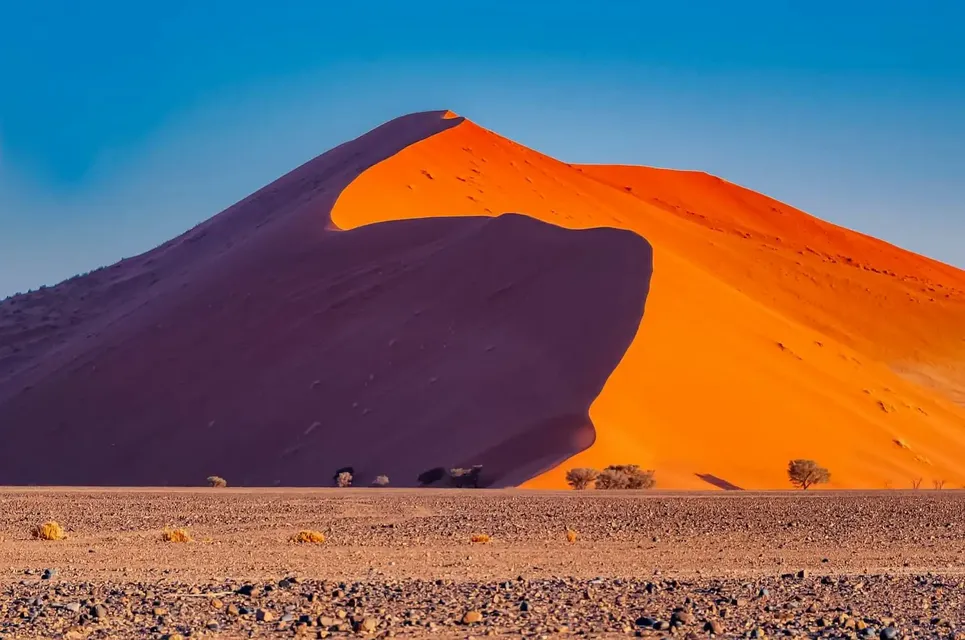
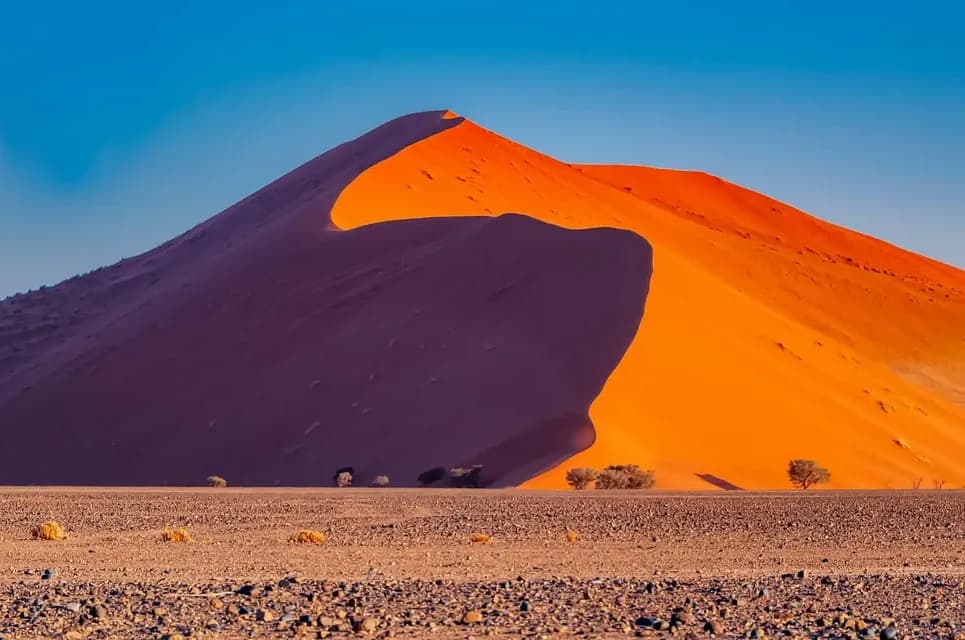
We’re nearing the end of our adventures here in Namibia, but something feels like it’s missing, right? So let’s get moving! We wake up early and set off once again. We still have quite a journey ahead, with our compass pointing south as we enter the Namibian desert, characterized by towering sand dunes in incredible shades ranging from pink to orange to red. We have all the time in the world to soak in the view: the trip will take about five hours, and the morning will fly by as we keep our noses glued to the windows, eager not to miss a single detail of what Mother Nature has crafted in this part of the world.

We arrive at our destination in the early afternoon, entering Namib-Naukluft National Park, where we’re immediately surrounded by the towering sand dunes we had only imagined or seen from afar earlier. The colors are simply breathtaking: each dune is unique, with their hues resulting from the ferrous composition of the sand and its oxidation—those that are the oldest appear a deep red. We don’t waste any time and set off to explore the area: here lie some of the highest dunes in the world, reaching almost 400 meters in height!

Skeletal trees stand on a cracked white clay pan, casting shadows in front of a large orange sand dune under a deep blue sky.
Day 9

Sossusvlei and Deadvlei

Nature and adventure
Relax
Skeletal trees stand on a cracked white clay pan, casting shadows in front of a large orange sand dune under a deep blue sky.
Incredible landscapes await!

Once again, we find ourselves in the park that enchanted us yesterday. However, two of the most spectacular locations are still on our list: Sossusvlei and Deadvlei. First, we head to Sossusvlei, a lake that is mostly dry and covered with a crust of salt sand. Will it feel like we’re on Mars? The impression is spot on!

Next, we move to one of the most famous and photographed spots in all of Namibia: Deadvlei. This depression of white sand is surrounded by towering red sand dunes. The most striking feature here is the dead acacia trees, whose dark brown or black silhouettes create an incredible contrast against the vibrant landscape. Once, there was an oasis of acacias fed by a river that eventually changed course, leaving behind one of the most evocative places on Earth. Let’s grab our cameras; in this stunning setting, it’s impossible to take a bad photo!

Three people from a WeRoad group trip sit silhouetted on a pier, watching an orange sunset over the water with a mountain in the distance.
Day 10

Back to Windhoek

City and cultures
Relax
Party and nightlife
Three people from a WeRoad group trip sit silhouetted on a pier, watching an orange sunset over the water with a mountain in the distance.
Our last full day

After two days immersed in the surreal landscapes of the Namibian desert, it’s time to return to reality. We settle into our cars and set off back to where our journey began. The capital, Windhoek, awaits us, but first, let’s enjoy the African landscapes one last time from our windows. The drive will take about five and a half hours, giving us plenty of time to choose our favorite playlist and kick off a singing competition!

Around lunchtime, we arrive at the hotel, drop off our backpacks, and find a place to grab a bite to eat.

We have the afternoon free, allowing us to explore the city center and check out various points of interest. One highlight is Christuskirche, a church uniquely located amid the streets. We also can’t miss the Namibia Craft Center, where we can admire local craftsmanship and stock up on souvenirs to take home. If we’re craving a touch of nature, the botanical gardens are a perfect spot to revisit the days spent on the road among Africa’s stunning landscapes.

In the evening, we’ll gather for dinner one last time: the perfect opportunity to relive the best moments of our adventure and end on a high note!

Itinerary image
Day 11

Goodbye Namibia!

City and cultures
Relax
Party and nightlife
Check-out and goodbye

Check-out and goodbye – until your next WeRoad adventure!

What's included

What's not included

Roundtrip flight to/from destination

  • Food and beverages when not specified

  • All extras you'll be able to fit in your backpack

  • Anything not mentioned in the "What's included" section

Money pot

The Money Pot is approximately £210/€250 for this trip and is collected on-site by the Travel Coordinator on the first day. The amount of the Money Pot will vary based on the number of activities and extras that the group decides to do.

  • Entrance fees to the parks mentioned in the itinerary

  • Visit and/or activities within the Cheetah Conservation Fund

  • Coordinator's money pot share

  • All extra activities that each member of the group agree on doing and the coordinator's fee as well

  • Tips for our local service providers who will help make our tour unique. In this country, everyone expects it because tips are a large part of their salary. As responsible travellers we believe it’s appropriate to reward the services received by adapting to their local culture!

Additional info

Learn more about accommodation, transport, and other useful travel information.
  • Accommodation

    Hotels, B&Bs and private/public campsites.

    The no-sharing room option is not available for all departures.

  • Transport

    Private transfers.

  • Private Room Option Show all details

Why WeRoad

  • Small groups, on average 11 people

  • Free cancellation with 100% refund up to 31 days before departure

  • Book with a £/€100 deposit

The travel coordinators

Our travel coordinators are chosen because they are people like you. Not only are they the best travel buddy you could hope for, but they're trained professionals guaranteed to show you a travel experience like never before

Find your flight

For this trip, we recommend arriving and departing from these airports.

Arrival Hosea Kutako International Airport
Return Hosea Kutako International Airport

FAQs – Frequently Asked Questions

About this trip

What are the meeting and departure details for this trip?

This journey begins at Windhoek. On the first day, we meet at 18:00.

Your Coordinator will add you to the WhatsApp group for your trip about 15 days before departure.
 It’s a great way to start getting to know your travel mates, receive more details about the first day’s meeting point, and ask any pre-departure questions you might have.

This journey ends at Windhoek. On the last day, you are free to leave at any time, so whether you need to book a flight, a train, or wish to continue the journey on your own, you can organize your return as you prefer.

What kind of luggage can I bring with me on this trip?

For this itinerary, you can choose the type of luggage you prefer – we always recommend a backpack, but you can also travel with a duffel bag, a holdall, or (it breaks our heart to say it) a cabin trolley case or a checked suitcase, as long as it’s moderate in size. Our Travel Coordinator will suggest the ideal luggage before departure in the WhatsApp group!

About Namibia

What are the entry requirements for Namibia?

If you are a UK citizen, to find out the entry requirements for Namibia, you can check this informational page from our partner Sherpa. If you need a visa, you can apply for it through Sherpa. If you are not a UK citizen, you can still use Sherpa by changing the nationality in the 'Passport' section.

Before traveling, always remember to check the government website of your country of origin for updates on the entry requirements for Namibia – you wouldn’t want to stay home due to a bureaucratic detail!

What's the time zone in Namibia?

Namibia operates on Central Africa Time (CAT), which is UTC+2. Namibia does not observe daylight saving time. If it is 12pm in the UK, it will be 2pm in Namibia. If it is 12pm in New York, USA, it will be 6pm in Namibia.

Which currency is used in Namibia?

Namibia uses the Namibian Dollar (NAD) as its currency. The exchange rate can vary, but typically:

  • 1 GBP equals about 20 NAD
  • 1 USD is around 15 NAD
  • 1 EUR is roughly 18 NAD

You can exchange currency at banks, exchange bureaus, and some hotels in major cities.

How can I pay in Namibia?

You can pay in Namibia using cash or credit cards. Credit cards like Visa and MasterCard are widely accepted in hotels, restaurants, and larger shops. However, it is good to have some cash for smaller establishments or rural areas where card payment might not be available. ATMs are prevalent in towns and cities, so withdrawing cash when needed is easy. Remember that bank fees may apply when using your card or withdrawing cash, so check with your bank for details.

Do I need to tip in Namibia?

Tipping in Namibia is appreciated but not compulsory. In restaurants, a 10 to 15 percent tip is generally a nice gesture for good service. For taxi drivers, rounding up the fare is common. If you're on a guided tour, consider tipping your guide and driver separately:

  • About 10 to 15 USD per day for the guide
  • Around 5 to 10 USD per day for the driver

Remember, tipping is at your discretion and should reflect the quality of service you receive.

What's the internet like in Namibia? Should I buy a SIM card? How available is Wi-Fi?

In Namibia, Wi-Fi is available in most hotels, cafes, and restaurants in urban areas, but it might not be as reliable or fast as you are used to in Europe or the USA. If you plan to travel to more remote areas, you might consider buying a local SIM card or an e-SIM data plan for more reliable connectivity. Providers like MTC and Telecom Namibia are popular choices and offer good coverage throughout the country. You can purchase a SIM card at the airport or local shops. Make sure your device is unlocked for international SIM use.

What language do they speak in Namibia?

In Namibia, the official language is English, so you'll have no problem communicating. However, there are several indigenous languages spoken across the country, including Afrikaans, Oshiwambo, and Otjiherero. Here are some useful expressions you might hear or use:

  • Hello: Hallo (Afrikaans)
  • Thank you: Dankie (Afrikaans)
  • How are you?: Ongaipi? (Oshiwambo)
  • Good morning: Morokeni (Otjiherero)
What kind of plugs are used in Namibia?

In Namibia, the plugs used are type D and type M, which have three round pins. The electrical voltage is 220-240 volts with a frequency of 50 Hz. If you're coming from a country with different plug types, we suggest bringing a universal adapter to ensure your devices can be used without any issues. Always check your device's voltage compatibility to avoid any damage.

What’s the main religion in Namibia?

Namibia's main religion is Christianity, with the majority of the population identifying as Christian. Most belong to denominations such as Lutheran, Roman Catholic, and Anglican. While there are no strict religious dress codes, especially for visitors, it's always respectful to dress modestly when visiting religious sites. Important religious holidays include Christmas and Easter, which are widely celebrated across the country.

What should I pack for Namibia?

Packing for Namibia means being prepared for diverse climates, from desert heat to cool evenings. Here's a handy guide to what to put in your backpack:

  • Clothing:
    • Lightweight shirts and shorts
    • Long-sleeve shirts for sun protection
    • A warm jacket for evenings
    • A hat for sun protection
  • Shoes:
    • Comfortable walking shoes
    • Sandals
    • Hiking boots if you plan to trek
  • Accessories and technology:
    • Sunglasses
    • A good camera or smartphone for photos
    • A universal adapter for electronics
  • Toiletries and medication:
    • Sunscreen
    • Insect repellent
    • Basic first aid kit
    • Common travel medication like pain relievers and antihistamines

Namibia's climate can be extreme, so layering is key, and sun protection is a must.

What’s the weather like in Namibia?

The weather in Namibia can vary greatly depending on the region:

  • Coastal areas: Like Swakopmund and Walvis Bay, the climate is mild with cool, foggy mornings and warm afternoons. The best time to visit is from November to April for warmer weather.
  • Desert regions: Such as the Namib and Kalahari deserts, expect hot days and cooler nights. The best time to visit is from May to October when the temperatures are more moderate.
  • Northern regions: Like Etosha National Park, it can be very hot, especially from October to December. Visit between May and September for cooler, dry conditions ideal for wildlife viewing.

Remember, Namibia’s seasons are opposite to those in Europe and the USA. Summer runs from November to April, while winter is from May to October.

About WeRoad

Are flights included?

Return international flights are not included on our trips because we want to give you full autonomy and flexibility. You can choose your preferred airline, fly from the airport that works best for you, and decide how many stopovers you want to make along the way.

As flights are not included, you also have more flexibility with your travel dates: you could arrive at your destination a few days early or return home a bit later – or even continue independently to a nearby destination!

What does the "Available" status mean?

to-confirm.svg

An "Available" departure means that the trip isn’t confirmed yet and we’re waiting for a few more travellers to sign up… which could be you!

If you book the trip please wait for it to be confirmed before booking your international flights.

What is the Money Pot and how does it work?

The question of all questions! Here’s some more information: 

  • The Money Pot is a common fund collected in local currency from all travellers on the trip and managed by your Travel Coordinator. 
  • It is used to streamline payments for extra activities, goods and services that the whole group decides to do. This guarantees flexibility in choosing activities and excursions at the destination in line with the mood of the group. 
  • It is typically collected on the first day of the trip in local currency, although at times, the Travel Coordinator may ask for it to be paid before departure.
  • You’ll find the Money Pot amount on the website under the section ‘What’s included in the Money Pot’. To find this look for ‘What’s included’, scroll down to ‘Money Pot? Click here’ and you’ll find the details.
  • The amount varies depending on the destination chosen.
  • It is usually used for group expenses that all travellers decide to take part in, but sometimes if you opt out of an activity it might make more sense for it to come out of the Money Pot. In these cases the Coordinator will return the amount for this activity back to you at the end of the trip. 
  • It is estimated based on the experience of other groups but can vary depending on what activities your group is keen for. As such, the Travel Coordinator may need to increase the amount during the trip.
  • If not all of the Money Pot is spent, the difference will be returned to all travellers at the end of the trip. 
  • The Money Pot also covers the Travel Coordinator’s share of the activities included in the Money Pot, except for those activities that are free for the Travel Coordinator.
  • If you pay in advance for part of the Money Pot before the trip for certain non-refundable optional activities, unfortunately, the amount cannot be refunded if the trip is cancelled. 
What payment methods can I use?

We offer several payment methods to fit every need:

1. Credit or debit card (Visa, Mastercard, American Express);
2. Instalment payment with Klarna (you’ll pay for the trip in three equal amounts);
3. PayPal (for selected destinations);
4. Revolut Pay to pay even faster straight from your Revolut account.

Can I cancel or modify my booking?

Anyone who books a WeRoad trip has the option to cancel or modify the trip – including both the dates and the destination – free of charge up to 31 days before departure. In case of cancellation up to 31 days before departure, you will receive a 100% refund of the WeRoad trip price. If you make a change, a price adjustment will be applied to the new trip chosen – meaning, if the new trip is cheaper, we will refund the difference; if it’s more expensive, you will need to pay the difference.

If you’ve purchased the Flexible Cancellation Option (which you can add in the first step of the booking process), you can request a cancellation or trip change until 8 days before departure. In case of cancellation, you’ll receive a 100% refund of the WeRoad trip price, minus the cost of the Flexible Cancellation option. 

You can do it directly from your personal MyWeRoad account!
 
Within your booking you will find the "Change Your Trip" section at the bottom right, just underneath your booking details. You will be able to select a different date for the same trip, or a different trip entirely. Whether you are able to change the trip depends on the cancellation terms of your booking. For your original booking if you selected the Private Room, Flexible Cancellation or entered any discount code, gift card or voucher, before confirming the change we will let you know if anything isn't applicable to the new trip and you can decide whether to proceed or not. If you have any issues please do get in touch with the WeRoad team and we'll be able to help. 
 
It's not possible to move to a 'sold out' trip and with any trips that are 'on request' we will need to check availability with our local partners so please do get in touch if you want to move to an 'on request' trip. Please bear in mind that if the trip has the 'final spots' status, there may be no places left in either the male or female room.

How to request a cancellation or change to your trip? Send us an email at [email protected] or a WhatsApp on +447716573700. Please share the booking reference for the trip you want to cancel or change, and, in case of a change, the new trip you would like to join.

What type of accommodation should I expect on your trips?

For our trips we usually use locally owned accommodation instead of big hotel chains. It’s our favourite way to really experience the local culture and, whenever we can, support the local economy. Typically, you’ll stay in hotels, apartments, guesthouses and hostels with the same standard maintained across all trips in the same destination.

The list of accommodation for your trip will be shared with you by your Travel Coordinator 2-5 days before departure, along with other useful details for your adventure!

Can I find out my travel groups' flights?

Yes! We might not know the flights for everyone else in the group, but there are ways to find out which flights your fellow WeRoaders will be taking. 

1. All travellers can share their flight details after booking on their My WeRoad account so that other travellers on the same trip can see these details anonymously. 

2. Alternatively you can join our Facebook group: Solo Travellers | WeRoad Community – (here is the extended link: https://www.facebook.com/groups/963298767843213 ) Look for a post about the trip you’re interested in or ask the group admin for help in getting in touch with your future travel companions!

3. If the Coordinator has already been assigned to the trip you’re keen for, you can easily find their Facebook post on the website. Click 'Ask the Coordinator' and follow the link here. 


How is a group made up in average?

Our groups usually consist of 8–12 travellers, with a minimum of 3–4 and a maximum of 15. 
Everyone on our trips speaks English, and travellers join us from across the UK, Europe and beyond. Our trips are open to people in their 20s, 30s, and 40s, with an average age of 34 across all trips.

Each group will be joined and led by one of our experienced Travel Coordinators, who’s there to ensure everything runs smoothly and the group feels well-supported. 

If you’d like to know more about our typical WeRoad groups do reach out to us on WhatsApp on +44 7716573700. 

Can I see who’s in the group before I book the trip?

Yes! If you're curious, you can take a sneak peek at the group before booking. 
You’ll find the info in the ‘Group’ section for each trip on the departures page, showing how many WeRoaders have already booked. 

Click the little arrow and you’ll even see their gender and ages – but hey, that’s exclusive info, so we’ll ask you to log in or sign up to see that!

If a location is mentioned, is it guaranteed that we’ll spend the night there?

For some trips, in the itinerary section, you’ll find the number of nights and the location (not the hotel) where you’ll be spending the night(s). The location shown is the one we usually go for on most trips, but in some cases, you might stay in a nearby town. This will depend on logistics or availability of accommodation. 

The list of accommodation for your trip (and therefore also the exact locations) will be shared by your Travel Coordinator 2-5 days before departure, along with other useful information for your adventure!

Who is the Travel Coordinator and what is their role on the trip?

The WeRoad Travel Coordinator is an experienced and skilled traveller who will be the perfect companion for your trip. They will manage all the logistical aspects of the itinerary like transport, timings, accommodation, restaurant bookings and meeting points, so that you can enjoy the trip without this hassle. They’re there to support the group, ensure everything runs smoothly and will no doubt make the trip a lot of fun along the way too! 

The Coordinator will set up a WhatsApp group approximately 2 weeks before departure. This will be the moment to ask any pre-departure questions and get to know the rest of the group! If the trip you are interested in already has a Travel Coordinator assigned, you can contact them before booking. Their details will be on the trip page, or you can search for their name here. After booking, you will find their contact details in your My WeRoad account, under ‘Bookings and Trips’ > ‘Your Upcoming Trips’ > ‘Trip Details’.

Will I be sharing a room?

Yes, on all our trips you will share a room with other WeRoaders in your group. By default this will be people of the same gender, unless you tick ‘I'm OK with a mixed gender room’ when you book. The bathroom will either be private or shared only with other travellers on the trip. The rooms might be twins, triples, quadruples or multi-share (up to 8 people in exceptional cases), depending on the destination and availability.

You will never share with people from outside of the WeRoad group, except in certain cases for local experiences, which are specifically mentioned in the itinerary or communicated before booking. These typically involve specific nights in unique accommodation like tents, homestays, or camping, offering a more adventurous travel experience in exchange for some comfort.

On some of our trips we can offer a private room for an additional cost. Just tick the ‘Private Room’ option at checkout to get this added. For some of our trips if you book as two travellers together you can add this private room free of charge. Look out for this option at checkout. 

Please note that if you do book a private room with a friend/partner this could be either a double or a twin room so please email [email protected] if you have a preference on this. 

How can I be part of the WeRoad community?

When you set off on a WeRoad trip, you’re officially a WeRoader – and as we often say, 'once a WeRoader, always a WeRoader'. This means that once you’re part of the community, a little piece of WeRoad will always stay with you.

But you’re not just a WeRoader during your trips, far from it! The community is alive and active all year round: you can stay in touch by following and interacting on our social media channels, like the Facebook group or the Instagram profile. You can also come along to one of our many events that we run in different cities worldwide. Check out and sign up to our events by downloading the WeMeet app here

From $ 2,694