


Is this trip for me?
Party and nightlife
Relax
Nature and adventure
City and cultures
Monuments and history
Physical effort
Trip type
Any great trip to Japan should include some unmissable stops and, great news, we have them all covered: Tokyo, the frenetic modern capital; Kyoto, with its temples and historic neighbourhoods; Hiroshima, reborn after the Second World War; and Osaka, home of Japanese cuisine.
Modern meets tradition: in Tokyo we cross the busiest intersection in the world among skyscrapers, while in Kamakura we find the peace of Buddhist temples and Zen gardens, not far from the iconic Mount Fuji. The Shinkansen, the high-speed train with a reputation for never being late, takes us to Kyoto, its majestic temples, the bamboo forest and the traditional red gates of Fushimi Inari. Then a jump back in time in Hiroshima, Osaka and Himeji Castle, before Nara and its famous deer walking freely in the city park. A culture far from ours, waiting to be uncovered: are you ready?


1 night: Tokyo
Roundtrip flights or transportation to reach the destination are not included in the package, so you can decide from where and when you want to leave! This gives you complete freedom of choice to adjust your travel itinerary to your needs.
Hotel check-in in Tokyo and we gather for welcome meeting— click here to see how it works!

1 night: Tokyo
We kick off our day early to make the most of our adventure. First stop: Kamakura!
Exploring Kamakura: Kamakura is an ancient imperial city and one of the first capital cities of Japan, with temples and palaces that offer a glimpse into its rich history.
Inside the Great Buddha: the Great Buddha is a magnificent statue that has survived numerous typhoons and even a tsunami that ravaged the temple surrounding it. It’s one of the very few Buddha statues that can be visited from the inside. Shall we go in?
We head back to Tokyo by train, refreshed and ready to explore more of the city’s culture and history.
Temples of Ueno Park: Ueno Park is one of the most popular parks in the city, home to many temples and shrines. The most notable is the Gojo Tenjinsha Shinto shrine, which can be reached along a pathway lined with traditional red torii gates.
Dinner at Ameyoko Market: food is a fundamental part of any country’s culture, so tonight we eat in the vibrant streets of Ameyoko Market, near Ueno Park. Let’s get our taste buds ready!

1 night: Kyoto
Another early morning aboard one of Japan’s iconic bullet trains. Destination: Kyoto, known for its rich history and beautiful temples.
Bullet train ride: we experience the efficiency and punctuality of the Japanese railway system, travelling at high speed.
Looking out for Mount Fuji: will we be able to catch a glimpse of its snow-capped peak?
We arrive in Kyoto, one of the most picturesque cities in Japan, in the afternoon, check into our hotel and get ready to explore.
Strolling through Kawaramachi: in the neighbourhood of Kawaramachi we can stroll through streets full of shops and izakayas, typical small restaurants.
Street food at Nishiki Market: Nishiki Market is a must for any food lover, with street food stands offering sushi, sashimi, fresh fish, yakitori, gyoza and sweet treats like melon pan and matcha-flavoured ice-cream.
Gion at sunset: Gion is the district known for its traditional teahouses and geishas, and we’ll have the chance to spot geishas in traditional attire. Sunset is the best time to visit: it’s selfie time!

1 night: Kyoto
Today we delve deeper into Kyoto’s cultural heritage: there are 17 UNESCO World Heritage Sites and over 700 Shinto temples here, and we won’t have time to visit them all!
Up through Fushimi Inari: Fushimi Inari Shrine is a Shinto place of worship known for its thousands of red torii gates leading up to the mountain’s summit.
At Kiyomizu-dera: we also visit the iconic Kiyomizu-dera Temple, renowned for its sacred water.
After lunch, we head east to visit one of Japan’s emblems.
The Golden Temple: the Kinkaku-ji Temple, also known as the Golden Temple, is covered in gold leaves that create a stunning reflection on the pond when illuminated by sunlight. In Japanese culture, gold symbolises purification from negative thoughts, so we can expect to leave with clear and peaceful minds.
Ryoanji’s Zen garden: we end the day at Ryoanji Temple, where we can stroll through the largest Zen garden in Japan. Have we found inner peace yet?

1 night: Kyoto
An early start to beat the crowds in Arashiyama, the neighbourhood where we can get lost in the magical Bamboo Forest.
Into the Bamboo Forest: a place you may have seen on Instagram, probably one of the most photogenic places in Japan. We wander through the forest and park, surrounded by natural beauty and serenity.
At Tenryuji Temple: then we visit the Tenryuji Temple, one of the five Zen temples in Kyoto.
A free afternoon: what will it be?
Fancy some shopping? A leisurely stroll around the city and some shopping.
Time for an onsen? We can indulge in a traditional Japanese spa experience at an onsen.
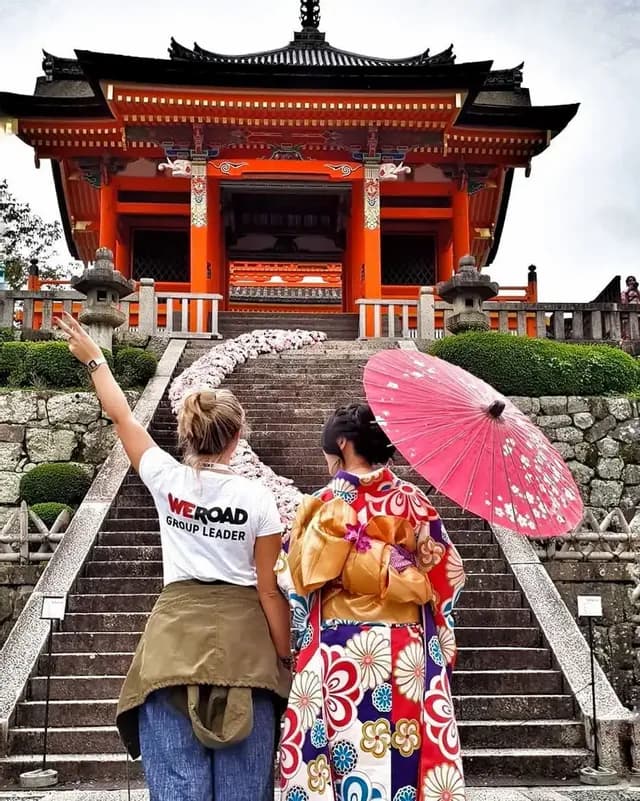
Dressing up in kimono? If we choose to, we can dress up in traditional attire, like the kimonos for women and hakamas for men worn by locals, and immerse ourselves in the local culture for a truly unique evening.

1 night: Hiroshima
We bid farewell to Kyoto, our home for the past three days: after a three-hour bullet train ride, we arrive in Hiroshima and make our way to the port.
Ferry to Miyajima: we board a ferry to Miyajima Island and its iconic Great Torii, a free-standing gate in the sea that creates mesmerising reflections on the water.
Street food on the main street: a leisurely stroll down the main street of the town, with a variety of street food options.
Be mindful of the friendly, yet quite hungry, deer wandering around the area!
Today we pay our respects to the tragic history of Hiroshima: on 6 August 1945, the city was destroyed in the first nuclear attack in human history and many lives were lost.
Visiting Memorial Park: Memorial Park is a solemn reminder of the devastating effects of that day, with memorials and monuments that honour the victims of the bombing.
Local voices, if possible: we may also hear from local guides who volunteer their time to keep the memory of this tragic event alive.

1 night: Osaka
We board the Shinkansen once more, destination Himeji.
Himeji Castle: its iconic castle has stood for over 400 years and miraculously survived the bombings of World War II.
Hunting for the perfect shot: we explore the city centre in search of the perfect viewpoint for a photo of the castle and its pagoda-style roofs. Film set vibes, anyone?
Osaka is the third most populated city in Japan and is renowned for being the most liberal one as well. Tonight we find out if what they say is true!
Guided food tour: an exciting 3-hour guided food tour to try a bunch of different local delicacies: Osaka is the food capital of Japan, after all.
Tasting okonomiyaki: a savoury pancake that one simply cannot skip during a trip to Japan.
Up to Osaka Castle: we walk up to Osaka Castle to burn off the calories, before living the Osaka nightlife.

1 night: Osaka
Nara was one of Japan’s capital cities, which is why it has so many historical and cultural sites. We arrive in the morning and have the whole day to explore temples, gardens and pagodas, and choosing what to visit will be a very hard task!
Meeting the deer: we can meet the 1,200 deer of Nara-koen Park. They’re semi-wild and roam freely, and we can buy a pack of deer crackers to feed them and win their hearts.
At the Daibutsu-den: we can start with Daibutsu-den, the biggest wooden building in the world, which enshrines a 17-metre tall Great Buddha.
Kasuga-taisha and Naramachi: then we can continue with Kasuga-taisha Shrine, the most important Shinto shrine in Nara, and Naramachi, the traditional district of shops, restaurants, workshops and ryokan (traditional Japanese inns).
We only have one day: let’s make the most of it!

1 night: Tokyo
Another bullet train journey and we’re back in Tokyo in less than 3 hours, ready to fully enjoy this megalopolis and its neighbourhoods!
Asakusa and Senso-ji: we start from Asakusa, the heart of old Tokyo, where we can dive into Japanese culture and history at Senso-ji Temple and its pagoda.
Street food by the temple: there are lots of food stands near the temple, so even today we get the chance to try out Japanese street food.
A wish with an omikuji: before leaving, we make a wish with an omikuji, a typical Japanese fortune ticket.
After lunch, we move to Ueno, a popular neighborhood with a huge park, many museums, temples, shrines and even a zoo.
Here in blooming season? If we are here around March and April, we can enjoy the cherry blossoms in Ueno Park as Japanese do. It’s called hanami, literally “flower viewing”.
Fancy a rowing boat ride? We could go on one if we feel like it.
Yanaka and Shinjuku: a stroll through the Yanaka District, one of the few areas that weren’t bombed during World War II, then dinner in Shinjuku and maybe a great night out with the locals in one of the many bars.

1 night: Tokyo
This morning starts in Harajuku, the street fashion neighborhood where crazy trends like Gothic Lolita or Ganguro originate.
Yoyogi Park and Meiji-Jingu: from modern times to older ones, with Yoyogi Park and Meiji-Jingu, a Shinto shrine dedicated to the Emperor.
Souvenirs on Takeshita-dori: a modern street full of shops, the perfect time to buy some souvenirs!
The Shibuya crossing: after lunch we go to Shibuya, a chaotic neighborhood that is always crowded, home to the busiest crossroad in the world. Can we ‘go with the flow’ like the many Japanese crossing it every day?
Believe it or not, we’re already getting close to the end of this trip.
Farewell dinner: what better way to celebrate than with a nice farewell dinner?
Karaoke night: then the utmost Japanese activity, karaoke! Let’s clear our throats, everyone sing!

Check-out and goodbye – until your next WeRoad adventure!

10 nights hotel in twin room with private bathroom

Local experience: three-hour local food tour in one of Osaka's iconic neighborhoods with English-speaking guide.

7-day Japan Rail Pass (Day 3 to Day 9)

Group Leader services

 Medical and baggage insurance - (coverage limits by destination country/region - €10,000 Italy, €20,000 Europe, €30,000 World, €50,000 USA/Canada)
Food and beverages unless specified
All souvenirs and extras that you wish to buy and will be able to squeeze in your backpack
Entrance fee to temples, museums, gardens and castles unless specified - approx. USD5-10 per ticket
Please see below extra optional activities that you can experience during your trip. Your Group Leader will be happy to assist with organizing these activities for the group. Availability may vary depending on location and group preferences.
Please note these activities are provided by third party suppliers and liability rests exclusively with these third party suppliers.
Cooking Class Kyoto - approx. USD 38
Kyoto Tea Ceremony - approx. USD 19
Gion walking tour with guide - approx. USD 25
Guide in Himeji castle - approx. USD 25
Nara Guide - approx. USD 25
Umeda Sky building - approx. USD 13
Ferry to Itsukushima (Miyajima) + island entrance fee - approx. USD 26
Skytree Tokyo - approx USD 15

Small hotels and hostels.
The first hotel will be shared with you at least 2 days before your departure by your Group Leader!

Tokyo underground, Shinkansen train for long distances and local transport when possible.

Our trips are led by a Group Leader who has been specifically trained by us to lead group travels to ensure you have the best time. A WhatsApp group with all travel participants will be created two weeks prior to departure by your Group Leader.

Backpacks are mandatory to allow easy transfers - we recommend a 45L backpack for our trips.
Why WeRoad
Small groups, on average 11 people
Move or change your trip for free up to 31 days before departure
Book with $ 0. Pay the $ 100 deposit only once the trip is confirmed
Find your flight
For this trip, we recommend arriving and departing from these airports.


