Group trips to Sardinia
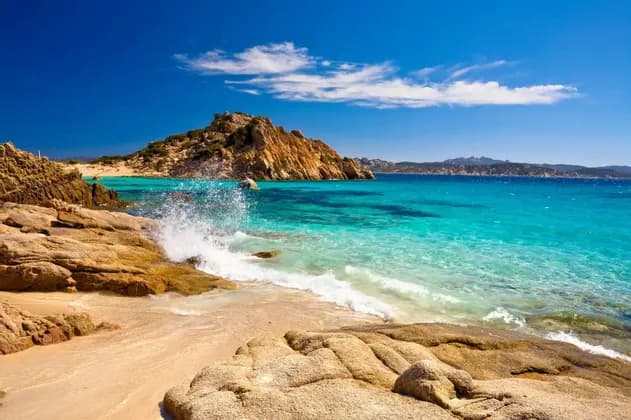
Pink granite and clear water, nuraghi over three thousand years old, and cliffs above the Gulf of Orosei: in Sardinia, you can go from a boat-only cove to a trail in the Supramonte. Our group tours to Sardinia take you there with fellow travelers who are up for the sea, snorkeling, and surfing.

Book with confidence
Book with $ 0
Lock in your spot and only pay once it's confirmed
Free changes
Switch dates or destination within 31 days, at no extra cost
Maximum Flexibility
With Flexible Cancellation, cancel up to 8 days before
Pay in installments
Spread the cost over time, interest-free
Which part of Sardinia should you choose?

The Northeast: Costa Smeralda and La Maddalena
This is postcard-perfect Sardinia: wind-sculpted granite, Mediterranean scrub, and water that shifts from green to blue in just a few meters. Ferries and boats depart from Palau for the La Maddalena archipelago, a national park with seven main islands and coves like Cala Coticcio, while the pink beach of Budelli can now only be admired from the water. Along the Costa Smeralda you'll find beaches like Capriccioli and Spiaggia del Principe, and farther south, San Teodoro and Budoni have long stretches of sand and a more laid-back vibe.

The Northwest: Alghero, Stintino, and Castelsardo

The East Coast: Gulf of Orosei and Supramonte
Between Cala Gonone and Santa Maria Navarrese, the coast transforms into a towering limestone wall hundreds of meters high, punctuated by coves of white pebbles. You’ll mostly explore this stretch by boat or dinghy: Cala Luna, Cala Mariolu, and Cala Goloritzé—famous for its rock spire—are the headliners. Some are even accessible on foot, provided you’re ready for some demanding trails. Behind them rises the Supramonte, the shepherds' plateau, where you'll find the Gorropu gorge, one of the deepest canyons in Europe, and the nuragic village of Tiscali, hidden away inside a sinkhole.

The South: Cagliari, Villasimius, and Chia
Cagliari is best explored on foot: climb up to the Castello district to catch the sunset from the Saint Remy bastions, then head down to Poetto, the city beach that stretches for about eight kilometers. To the east, Villasimius and Costa Rei offer white beaches and swimming-pool-clear water; to the west, Chia and Tuerredda mix dunes, Spanish towers, and small bays. In the Molentargius lagoon, on the edge of the city, you can easily spot pink flamingos in any season.
When to visit Sardinia
When it comes to the sea, the best months are June and September: warm water, long days, and more space on the beaches. July and August are peak summer, with food festivals, local festivals, and evenings outdoors, but also more crowds and higher prices, especially in Gallura. May and October are perfect if you want to mix swimming with hiking in the Supramonte, with milder temperatures and the interior still green. In spring and fall, sea storms send waves onto the west coast and draw in the surfers. Keep the mistral in mind, the northwest wind that can blow for a few days in a row: it cools things down, ruffles the sea, and sometimes changes boat plans, but it usually leaves clear skies behind.
What to see in Sardinia
Beyond the sea, Sardinia boasts more than seven thousand nuraghi, stone towers built from the Bronze Age onward. The most famous is Su Nuraxi in Barumini, a UNESCO World Heritage Site, which you can explore with a guide among the towers and the remains of the village. In the heart of Barbagia, Orgosolo features over one hundred fifty murals depicting social struggles and politics, and in Mamoiada, there's a museum dedicated to the masks of the Mamuthones—the true stars of the local carnival.
On the west coast, Bosa showcases colorful houses along the Temo River with the Malaspina castle perched at the top of town, while on the Sinis peninsula, the Phoenician-Punic ruins of Tharros gaze out to sea, near the quartz-grain beaches of Is Arutas. Further south, the dunes of Piscinas are among the tallest in Europe, and on San Pietro island, the village of Carloforte, of Ligurian origin, still thrives on tuna fishing. Near Cagliari, the archaeological site of Nora even has a Roman theater just steps from the water.
From the WeRoad blog


Sardinia is bigger than it looks on the map: Olbia and Cagliari are about three hours apart by road, and the SS131 highway, known as the Carlo Felice, is the main route linking the south of the island to the north. You can fly into Cagliari, Olbia or Alghero, or take a ferry from ports like Genoa, Livorno, Civitavecchia and Naples. Once you're here, the coastal roads are scenic but slow, and many coves can only be reached by boat or on foot, so it pays to pick one area and enjoy it at an easy pace instead of chasing the whole island.
At the table, the interior tells the story of a shepherd culture: pane carasau, culurgiones sealed by hand in the shape of an ear of wheat, pecorino and porceddu slow-roasted over embers. On the coast you'll find mullet bottarga, fregola with clams and Catalan-style lobster. Meals end with seadas with honey and a small glass of mirto, and among the wines, Cannonau and Vermentino di Gallura are worth a try.
Traditions here are still very much alive. On May 1 the procession of Sant'Efisio crosses Cagliari with thousands of people in traditional dress, in Oristano the Sartiglia stages a carnival joust on horseback with masked riders, and the shepherds' canto a tenore is on UNESCO's Intangible Cultural Heritage list. One rule to know: taking sand, shells or pebbles from the beaches is prohibited and can mean hefty fines. On a group tour, transfers, boats and stops are already organized, so you have more time to enjoy the sea and your evenings together.
FAQs

How does WeRoad work?
Choose your trip based on departure dates, destinations, and travel mood and... book it! Once you get the email confirming your trip, book your round-trip flights to and from the destination – they aren't included in the package, we love flexibility! 15 days before departure, your Travel Coordinator will set up a WhatsApp group so you can start getting to know your future travel buddies. You're all set: enjoy your WeRoad trip! You'll share incredible experiences, discover local culture, and live every minute to the max. (Want to know more? Read about How it works.)

Are there any age limits?
Yes. Our trips are organized by age group, so you'll travel with people at a similar stage of life, and we've got mixed-age groups, too. Finding the perfect WeRoad for you will be a breeze!

Is the flight included?
Flights are not included—we love flexibility! You choose your departure airport, airline, and layovers, and you can even add a few extra days on the island. Need a hand? Check out our flight booking support.

When's the best time for a group trip to Sardinia?

How many days do you need to see Sardinia properly?
It depends on how much you want to move around. A few days are enough to focus on a single area, but seeing the north, the south, and the interior takes more time, since getting around requires a bit of planning. A well-thought-out itinerary helps you avoid cramming in too many stops.

Is the north or the south of Sardinia better?
The north is often the go-to for its archipelagos, famous coastal resorts, and connections to La Maddalena; the south is handy if you want to combine Cagliari, beaches, and archaeological sites like Nora. The east is ideal if you're after wilder nature, trekking, and the coves of the Gulf of Orosei.

What is there to see in Sardinia besides the beaches?
Beyond the sea, it's worth visiting Barumini for the Nuragic civilization, Cagliari and its Castello district, Alghero for its Catalan influence, Bosa for its old town on the river, and Orgosolo for its murals. The Supramonte inland also shows you a very different side of the island.
How do you get around on a Sardinia tour?
The main gateways are the airports of Cagliari, Olbia, and Alghero. Once on the island, many of the most interesting places require road transfers and, in some cases, local boats to reach coves and archipelagos. Distances look short, but travel times can stretch because of the coastal and inland roads.

Is Sardinia only for beach lovers?
No. It also works if you want to mix beaches, trekking, archaeology, villages, and local food. The interior of the island has landscapes, traditions, and a pace of life that are very different from the beach areas.
Which traditional dishes are worth trying in Sardinia?
The classics to note down are pane carasau, culurgiones, porceddu, seadas, and bottarga. If you really want to understand Sardinian cooking, notice the difference between the coast and the interior: more fish and lagoon products near the sea, more meat, cheese, and traditional breads in the inland villages.