In a nutshell
- The best first-time Europe backpacking route is regional, not continental: choosing 3 to 5 stops in one area reduces costs, limits travel fatigue, and gives enough time to enjoy each destination instead of constantly moving.
- Central Europe is often the easiest beginner option thanks to affordable cities, efficient train and bus links, and a strong mix of culture, nightlife, food, and history in places like Prague, Vienna, Budapest, and Krakow.
- A realistic budget needs both daily spending and a safety margin: around €60-90 per day works for tighter budgets, while the 20% rule helps cover upgrades, delays, and unexpected changes without wrecking the trip.
- Transport and routing choices matter as much as destinations: open-jaw flights, scenic crossings, coffee-stop breaks on long transfers, and avoiding backtracking all make a first trip smoother and more memorable.
- Packing light and mixing accommodation types improves the whole experience: a smaller bag, versatile clothes, and a balance of hostels, private rooms, and guesthouses help preserve both flexibility and sanity.
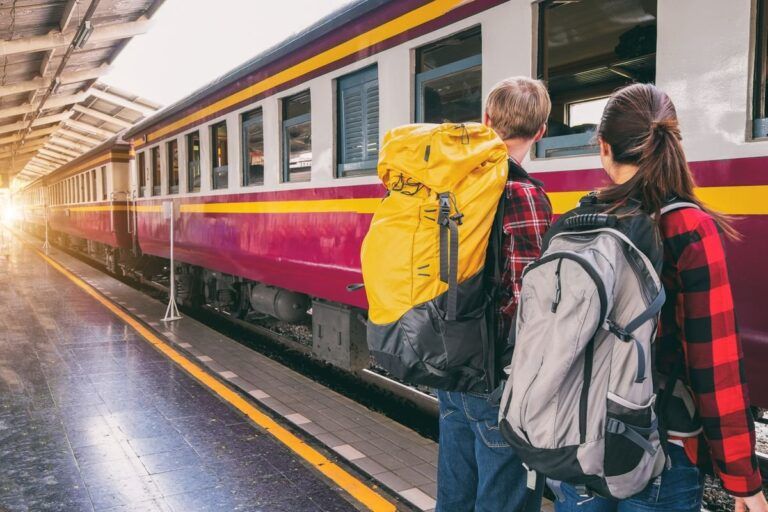
Europe has a way of making even the simplest train journey feel like a scene from a movie. One minute you’re grabbing a coffee at the station, the next you’re crossing into another country with a backpack, a half-charged phone, and snacks that probably won’t last as long as you thought.
Choosing the right route and knowing a few practical tips can make your first backpacking trip through Europe much smoother, leaving you more time to enjoy the journey and less time worrying about logistics.
If it’s your first time backpacking around Europe, don’t try to see the entire continent in one trip. The best journeys leave room to slow down and actually enjoy the places you visit. Choose a route that makes sense, give yourself some flexibility, and set a realistic budget. You’ll spend less time rushing between trains and more time making memories, and hopefully a little less time staring at departure boards wondering where on earth your platform is.
Why Europe is ideal for a first backpacking trip
Europe is one of the easiest places to start backpacking because transport is reliable, distances can be short, and the variety is huge. You can move between major cities, small towns, coastlines, and mountain regions without needing extreme planning skills, which makes the learning curve much gentler for first-time travelers.
You can have a classic city break in Paris, hop to canal life in Amsterdam, then head south for pasta, cliffs, or thermal baths. English is widely understood in many destinations, public transport is generally efficient, and budget options exist in almost every country.
That said, Europe rewards strategy. If your route zigzags like a toddler drew it with a crayon, you will lose time and money. The best first trip is not the one with the most countries; it is the one where you still have energy to enjoy day eight without becoming emotionally attached to convenience-store sandwiches.
How should your Europe travel route be as a first timer?
Your first Europe route should be regional, simple, and paced around efficient connections. Instead of jumping from one famous landmark to another across the continent, choose a cluster of nearby destinations and stay at least two or three nights in each place whenever possible.
This approach helps you avoid wasting half your trip in transit. It also gives you time to experience neighborhoods, not just check off monuments. A first-time route usually works best with 3 to 5 stops in two weeks and 5 to 7 stops in three to four weeks, depending on distances.
Smart route rules for beginners
A practical route should move in one direction, keep travel legs manageable, and balance big cities with slower moments. Good planning reduces costs, prevents burnout, and makes the trip feel more immersive instead of rushed.
- Pick one region rather than all of Europe at once.
- Avoid backtracking unless there is a strong reason.
- Stay longer in fewer places to save money and energy.
- Mix major capitals with smaller towns or nature stops.
- Book open-jaw flights when possible: arrive in one city, leave from another.
That last point can make a huge difference. Flying into one city and out of another at opposite ends of a country, with a single overland bus or train leg in the middle, often creates a much cleaner route than doubling back. It is the travel equivalent of finishing your meal before dessert arrives: deeply satisfying and far less messy.
Best backpacking routes in Europe for first-timers
The best routes for beginners are the ones with logical transport links, a balanced pace, and enough variety to keep the trip exciting. Central, Western, and Southern Europe all work well, but the right choice depends on your budget, season, and travel style.
| Route | Best for | Typical stops | Budget level |
|---|---|---|---|
| Central Europe loop | Easy logistics and great value | Berlin, Prague, Vienna, Budapest, Krakow | Moderate |
| Western Europe highlights | First iconic trip | London, Paris, Brussels, Amsterdam | Higher |
| Southern Europe mix | Food, coast, slower pace | Barcelona, Nice, Florence, Rome | Moderate to high |
| Balkans sampler | Lower costs and fewer crowds | Ljubljana, Zagreb, Split, Kotor | Lower |
Central Europe loop
Central Europe is often the strongest first choice because it combines affordability, cultural depth, and simple transport. Distances are manageable, trains and buses are frequent, and the cities are rewarding without being as expensive as Western Europe.
This route works especially well for first-timers who want castles, old towns, nightlife, museums, and hearty food without watching their budget evaporate in real time. If you want one polished version, think Prague, Vienna, Budapest, and Krakow.
If you are renting a car for part of the journey, a closed loop can be useful too. Starting and ending in the same city while linking together castle stops and even an underground salt mine along the drive can turn what would be scattered day trips into one cohesive route. Much tidier, much smarter, much less “wait, where did we park?”

Western Europe highlights
Western Europe is ideal for travelers chasing classic bucket-list cities and polished infrastructure. It is easy to navigate, but it usually costs more, especially for accommodation, food, and attractions in major capitals.
This route suits first-timers who want the famous names: London, Paris, Brussels, and Amsterdam. Keep expectations realistic and build in time for smaller moments, like a neighborhood market or a park afternoon, so your trip does not become a blur of queues and photos taken at suspiciously similar angles.
Southern Europe route
Southern Europe suits travelers who prefer a slower rhythm, stronger food culture, and a mix of cities with coastal scenery. Connections can still be easy, but peak summer heat and crowds make pacing especially important.
One simple version runs from Barcelona to Nice, then onward to Florence and Rome. If you add islands, do it deliberately. Setting aside one full day, boat there and back, for an island stop keeps the logic of a land-based coastal route intact instead of letting one dreamy detour wreck the rest of your timings.
On coastal routes, transfers can become part of the experience. Walking an entire cliffside coastal stretch from around 600 metres above sea level down to the water, linking one town to the next, is a far better way to move than hopping on a bus for ten forgettable minutes. Your legs may send formal complaints, but your memory will thank you.
Budgeting for backpacking in Europe
A realistic budget for Europe depends on destination, season, and comfort level, but first-timers should plan enough for accommodation, transport, food, activities, and an emergency cushion. The smartest budget is not the absolute cheapest one; it is the one that keeps the trip sustainable.
A solid daily estimate looks like this:
- Budget style: €60-90 per day
- Mid-range backpacking style: €100-160 per day
- More comfort or private stays: €170+ per day
These figures usually exclude international flights. Western and Northern Europe tend to be pricier, while Central and Eastern Europe often deliver better value.
The 20% rule and what it means
The 20% rule means keeping around twenty percent of your total budget untouched for unexpected costs. It is one of the simplest and most useful budgeting rules for backpacking because travel rarely goes exactly to plan.
That extra cushion can cover:
- A last-minute train or bus change
- A private room when dorm life becomes too much
- Higher food costs in expensive cities
- Unexpected entrance fees or baggage charges
- Minor emergencies and travel hiccups
Is $5000 enough for 2 weeks in Europe? Yes, for many travelers it is more than enough, especially with smart flights and a balanced route. In expensive countries, you still need to track spending, but it is a healthy budget for a first trip.
Where to stay when backpacking Europe
Hostels remain practical, but first-time backpackers do not need to rely on dorm beds alone. A mix of accommodation styles usually creates a better trip by balancing social opportunities, privacy, budget, and rest.
Useful options include:
- Hostel dorms for social energy and lower prices
- Private hostel rooms for comfort without losing atmosphere
- Guesthouses and B&Bs for quieter stays
- Budget hotels when splitting costs with a friend
- Serviced apartments for longer stops and self-catering
Book at least your first stay in advance. Arriving in a new city tired, hungry, and dragging a bag over cobblestones while comparing twelve accommodation tabs is not a personality-building exercise anyone needs.
How to backpack Europe for beginners: transport and packing
First-time travelers to Europe should focus on simple transport choices and packing light. Trains and buses are usually the easiest ways to move between cities, while a compact bag makes every transfer, station staircase, and hostel check-in significantly easier.
Choosing the right transport
The best transport option depends on the route, budget, and distance. In many cases, trains are the easiest and most comfortable, while buses can save money on shorter or medium-distance routes.
- Use trains for scenic and medium-distance journeys.
- Use buses when prices are much lower and timings remain reasonable.
- Use flights only for long jumps or awkward overland connections.
- Compare point-to-point tickets before buying a rail pass.
One underrated trick is breaking up a long overland transfer with a short coffee stop in a small town along the way. It makes the day feel human again. You get a breather, a local café, and a route that feels less like a punishment designed by someone who hates knees.
Also, some border crossings deserve more imagination than a motorway transfer. Crossing between two countries by a two-hour boat ride through a narrow canyon lake can turn an administrative move into the highlight of the day. If the route offers something like that, choose the memorable version.
What to pack
Your packing list should stay light, versatile, and realistic. Europe has shops, laundromats, pharmacies, and civilization in general, so you do not need to carry your entire identity on your back.
- One carry-on or medium backpack
- 3 to 5 mix-and-match outfits
- Comfortable walking shoes
- Rain layer and light jacket
- Universal power adapter
- Phone, charger, power bank
- Travel-size toiletries
- Passport copies and insurance details
Prioritize layers, machine-washable clothes, and shoes that are already broken in. Cobbled streets have ended many footwear delusions before.
Safety and common first-timer mistakes
Europe is generally manageable for independent travel, but first-timers still benefit from a few basic safety habits. Most issues are minor and avoidable, especially when you stay aware in transport hubs, crowded tourist areas, and nightlife districts.
- Keep valuables secure in crowded areas and on public transport.
- Do not overpack; heavy bags make every day harder.
- Factor in travel time, not just distance on the map.
- Use offline maps and keep key bookings accessible.
- Leave flexibility for weather, delays, and fatigue.
The biggest mistake is trying to do too much. You do not win Europe by speed-running it. You win by having enough time to enjoy where you are, eat something good, and occasionally sit down without checking the next departure board every seven minutes.
The details that matter: our tips
The parts of a trip people photograph are rarely the parts that make it work. What actually holds a route together are the small logistical calls made days before departure and the willingness to change plan when the terrain doesn’tcooperate.
Take mountain crossings: a high pass that’s open in July can be shut by October, so it’s worth checking the season before counting on it and keeping a cable car in mind as the way around, not just a backup.
The same instinct pays off on the water. A border between two countries can be crossed by road, but taking a boat across a canyon lake instead turns a formality into the best two hours of the day. And the last stretch of a trip deserves the same attention as the first: rather than killing time at a gate, a stop at a thermal complex near the airport turns those dead hours into the one you’ll actually remember.
Make your first Europe trip work for you
The best first trip is the one that matches your pace, budget, and curiosity. A regional route, realistic daily spending, lighter packing, and efficient transport choices will do more for your experience than trying to cram every iconic city into one heroic but exhausting itinerary.
Travel slowly enough to remember places, not just stations. Leave room for scenic transfers, small-town pauses, and smart route choices that make the journey itself part of the story. And if you want to explore the continent with the right balance of independence and shared experiences, discover the WeRoad group trips in Europe for a first adventure that feels exciting without the chaos.
FAQ
- How long should a first backpacking trip in Europe be?
-
Two to three weeks is a great starting point. It gives you enough time to visit several destinations without turning the trip into a constant rush. For two weeks, aim for 3 to 5 stops maximum.
- Is Eurail always the best option for first-timers?
-
Not always. A rail pass can be useful on certain routes, but point-to-point tickets booked early are often cheaper. Compare train, bus, and flight costs before deciding.
- Should I book all accommodation before leaving?
-
Not necessarily. Booking the first few nights and any high-season or must-stay places is a smart idea. After that, some flexibility can help you adapt your route and pace.
- What is the best season for backpacking in Europe?
-
Spring and early autumn are often ideal. You usually get milder weather, fewer crowds, and better prices than in peak summer, especially in major cities and coastal destinations.
- Is backpacking in Europe only for young travelers staying in hostels?
-
Not at all. Backpacking today is more about traveling light and moving flexibly than sleeping in dorms every night. Many travelers mix hostels with private rooms, guesthouses, and budget hotels.